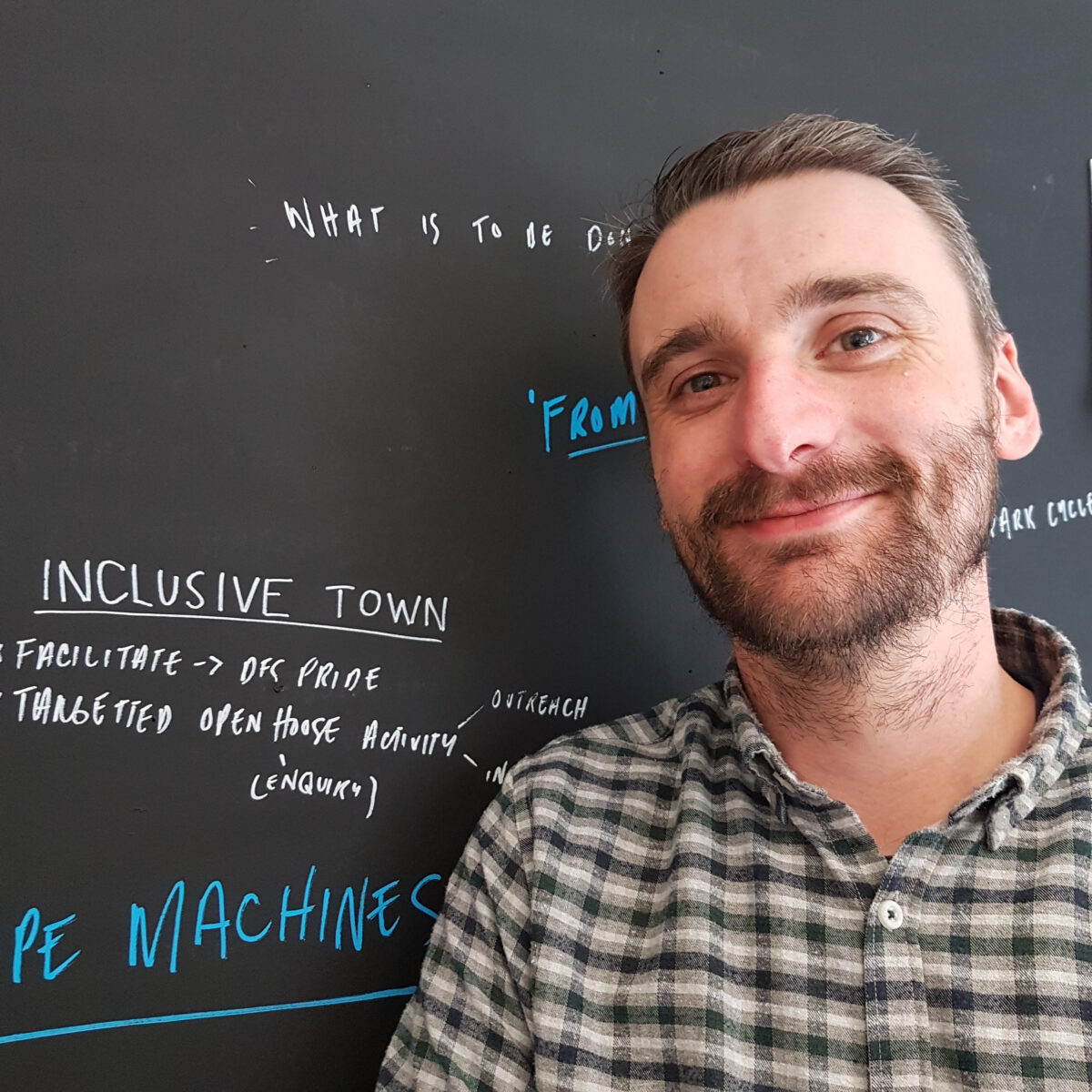
Our Story Weaver, Kaska Hempel, talks to Martin O’Neill from the Stove Network in Dumfries.
The story is the fourth in a five-part Dumfries series of Everyday Changemakers.
Credits
Interview, recording and sound production: Kaska Hempel
Transcript
Martin O’Neill: My name is Martin O’Neill. I’m the artistic director of the Stove Network. Stove is based in 100 High Street, Dumfries.
We are an arts and community organisation founded, maybe 11 years ago now. And our mission or what our organisation does is combine creativity and culture in the widest possible sense with community action, grounded by an ethos which is grow your own culture. So we believe that the making, participation and sort of activation of culture should be held by the people who live here, you know..
Kaska Hempel: Great. And do you live in Dumfries yourself?
Martin O’Neill: I do, yes. Born and bred.
Kaska Hempel: Great. so you know a lot about the place. Before we go further, for people who don’t know, what is an artistic director?
What do you do? Describe every day. Yes. An average day. Is there an average day?
Martin O’Neill: An average day? Oh, eh, no, there’s not quite an average day. So, an artistic director, I think if you were to say to somebody in the arts, eh, traditionally they would think of them as, like theatres and they choose the programme, they maybe direct shows or, em, or I suppose in visual arts sense, like the curator or whatever.
Mine is rather unusual, title for the type of work that I do, as we are predominantly facilitative. So I design sort of the processes and support community groups and support individuals such as young people that we’re working with to create spaces. which is our emerging artists platform, , as well as I hold the program in terms of the events that we put on.
I support the community groups to realise them, to achieve their long term ambitions. I work across different partners, different sectors in order to kind of realise that to the best impact that they can possibly have. And day by day looks very different. Could be a podcast one day, it could be a creative development meeting with Somebody from the museum, or it could just be a lot of admin one day, you know, or writing funding applications, which has been the last few weeks.
Yeah, it’s quite a diverse role, which is very difficult to describe, but I suppose it’s facilitative, flexible and creative um very much see myself as the in between sort of nature of stuff rather than being overly fixed on one particular role or one particular thing.
Kaska Hempel: Since you’re from Dumfries, I’m going to ask you about a favourite place that you’ve got in town. And could you describe it for our listeners?
Martin O’Neill: A favourite place? Oh, there’s a few favourite places. For my own social life, the Douglas Arms on the Vennell is a fantastic pub, ran by a dear friend of mine.
Since, beginning, it has managed to really challenge the idea of pubs and what they kind of represent. You know, there’s a lot of dry stock, so you don’t necessarily need to go in and have a beer. but it’s very much become a space for particularly the LGBTQ community as well.
There’s lots of pride events, lots of kind of events that are catered that way or angled that way. It’s a really inclusive space. It’s just, it’s really challenged the whole idea, , I think, of people’s relationship to pubs in the town, certainly, in a rural sort of setting. , Town in Scotland. So that’s my favourite place.
Kaska Hempel: And I guess I mean, we’ve kind of got the gift of our river.
Martin O’Neill: So, walking by the river, having that real connection to a river and, just how close we are to having a sort of real rural place to live in. You walk five to ten minutes down the street and you are in the countryside. So, It’s great to have that mix and that blend of things.
So if you need to ever get away, you can. You can kind of walk into nature.
Kaska Hempel: What was your personal journey into this work? How did you end up working with The Stove and especially reflecting on climate emergency or issues in Dumfries or community aspect of your work?
Martin O’Neill: I studied in Edinburgh doing theatre directing of all things and then moved to Glasgow with a view to starting that career, however naively it was, in a, you know, rather dreary economic situation in the arts at the time.
Generally I did a few odd jobs here, freelancing, etc, diversity of stuff, which, I did get rather disenchanted by the whole production of things and felt that a lot of the stuff I was working on didn’t particularly feel all that, I don’t want to say not interesting, I mean there was certainly some interesting plays etc that we worked on but I never got the sense that much of this was really speaking to anyone outside of the usual bubble.
For better or worse, I mean, but I really appreciated that time, on moving back. I, wanted to just get back into, you know, saving some money, et cetera, and being a bit more kind of grounded in my own town, which was challenging to begin with. and, you know, worked in, , pubs, worked in various different roles for quite a long time.
I first heard of The Stove, Through just a conversation with our now CEO, Matt. This was a good nine, god, nine, ten years ago now. And just was keeping an eye on what they were up to. A position opened up, what was called at the time a curatorial member, which was a freelance position. I think it was like two meetings per month that was effectively a co Artistic Director.
So we were a very, very small operation back then, very much a sort of artist collective. Over the last eight years, that’s really expanded to becoming a really major organisation within the landscape of, if not Scotland, and certainly the south of Scotland and employing far more people now than I can keep track of.
I guess from a personal standpoint, and the reason for getting so embedded and interested in this work is obviously having grown up in this place, culture always felt something outside of the thing that you did. It was kind of an unusual thing to be interested in, and the opportunity to engage with it outside of the more traditional ways was kind of difficult to do.
So, something which recognised that, and positioned itself in the centre of town was really important. really appealing and interesting to me. Not without its own controversy in the beginning, because it did feel as though, particularly regeneration narratives,and artists moving into sort of spaces, et cetera.
There has been a negative impact in some areas around that, but grounded to the real values of what this is about, and particularly , the lens of community ownership around this has been massive in terms of protecting, the values, but protecting how we want to see the future for our town.
And wrap it into that, the sort of wider net zero and climate based work and everything that we do is based on localism and how, globalized,things can sort of impact even the smallest examples and even locally. There’s a real golden thread of that towards understanding the impact of climate, whether it be economic, whether it be societal.
I think when we think of climate, the picture in your head is the weather report, but actually the climate conversation, the climate, you know, issue is actually much, much, broader than that. It’s tapped into everything, our own senses of identity, our own sense of how we live. Our own senses of community and of place.
So to be able to host that conversation indirectly, I feel is really important and seed of each of those conversations relates to our connection with our place and our connection with the way that we live in our world, and how we mitigate the impacts to it even further.
So, It’s a fascinating place and to do that through a really inclusive and accessible and open format kind of way where nobody needs to step into a space and feel disempowered by the knowledge that’s in the room. Everyone kind of comes in a bit neutral and it’s about an open exchange and learning and appreciating what people have to offer to that conversation, both positive and negative because, however you might perceive that.
I think it’s important to have a civic space to do that and make it accessible is one of the great joys of what I do, I think.
Kaska Hempel: Now we tried to jargon bust, a little bit, as part of this. And I’m just going to throw a phrase at you and I want you to say the first thing that comes to your mind.
Okay. Maybe then explain in plain terms. Yeah. For like an innocent bystander. To what it means. Creative placemaking.
Martin O’Neill: Nice, a nice easy one, eh?
Creative placemaking is the idea that in order to realise the ambitions of a place, the process for that needs to be rooted in imagination and in creativity.
And we view creativity as not necessarily a thing that an artist does, but that creativity is actually innate to how we live our lives, effectively. Creativity it’s kind of taught out of us, I think. So it’s a reclamation towards getting to that, you drew before you walked. So yeah, creative placemaking, as opposed to placemaking, which is sort of understood as a little bit more like public space architectural.
This is really about grounding that to like how people really do respond to their places and how they work with them. Whether that be with institutions, whether that be with organisations, whether that be with their employment or opportunities, etc. It’s really about having the greatest conversation about our places, but doing it in a way that is creative, innovative, imaginative and facilitative towards other people’s ideas.
The best example in terms of one output, I mean, the outputs can be so diverse, but for our own sake was the formation of the Midsteeple Quarter, which started off as a Stove Network project. It’s now very much its own independent community benefit society, its own board, its own staff,
The genesis of this was around, exploring the rights of people, to impact on the town that they live in. And I think it’s a very similar story across the UK. And various many other places that capitalistic dominance of ownership and private ownership, whether that be hedge funds, et cetera, has really had a massively detrimental impact to, our high streets and town centers.
So even starting this conversation around, well, what does it look like to have the community owning this, And we did that for your various creative means. It started off with a documentary. And then it moved into a takeover of council assets that then moved to the community asset.
And since then, more buildings have been purchased through the campaign, through lobbying, through funding, through fundraising from the community as well towards actually achieving those aims that were stated there, which. from a national lens became quite a radical step for a town to be doing and indeed it is radical.
But day by day it seems less so and it’s just part of the norm and I think , that idea of creative placemaking is just a sort of jargoned language towards actually what should become and will become the norm for our places which is greater community resilience, greater community ownership and greater embedded enterprise and business happening. Connected to net zero campaigns, connected to policies in regards to that which stimulate and grow and create a more sustainable and fairer future for everyone.
Kaska Hempel: Is there any other creative projects that are particularly personally resonating with you? Because you’ve got so many different things happening.
Martin O’Neill: Yeah. I mean there’s so many that I could talk about.
One that I feel particularly emotional about is through our work with what’s called the Open Hoose. This project came about after the pandemic when nobody could gather or we didn’t know what was kind of going on and you could be in with a certain amount of people at six meters distance and all this stuff.
So it was really causing really massive problems in terms of like social isolation, anxiety and you know, we all felt it. We all really felt it. But even more particularly, those who are most vulnerable felt it most in our community. So, Open Hoose was a way of us getting back in the building, getting back in our venue.
And we just, not knowing what exactly people felt comfortable with, we just opened the doors and said, what do you want to do? And that was done through an inquiry form, which, it just literally stated, what would you like to do and how do you see us supporting it? With a view to regathering and launching new activities or events.
We kicked off with up to 15 new projects and events. They ranged from wire sculpture to a musical jam night to a bread making club to a climate kitchen. And since that point, we now have a core portfolio of 10 community based projects.
That is our foundation now. That is what we really focus on. And hopefully come the new year, we’ll be open to more new projects. But since that, over two years ago, three of the projects are now constituted. So one is now a Scottish charity. The other one is a community interest company.
And so is the other one as well. And they are as diverse as LGBTQ plus variety nights for emerging performers, creating a safe space in order for them to actually experiment with what they’re doing, to bread making clubs, which are become absolutely massive to climate cafes, which explore kind of different local based issues and draw in new workshops and expertise towards doing that.
So, to have such a kind of risk taking idea that it’s like, we’re just going to throw out our programming and see what happens, see what comes back. It’s just been amazing to see in terms of the benefits that it’s brought to people, both from an enterprise perspective, but also from a really personal perspective. Seeing people connecting and learning and making new friendships and new networks and new campaigns and actually launching new careers through it as well. It’s just been amazing to see so that’s my own personal one.
Kaska Hempel: You mentioned that you’re writing a big grant proposal at the moment. How will you celebrate once you submit it? What’s your go to?
Martin O’Neill: Pints in the Dougie, I think. If we get it, maybe something a bit more extravagant.
Kaska Hempel: What’s the biggest challenge The Stove has had to overcome? While keeping the project going because you’ve been around for a while and what lessons you learn from it just to share it with people that might be wanting to do a similar project or start something similar.
Martin O’Neill: The biggest challenge I suppose is in balancing the amount that you have to do in order to exist with maintaining a sense of the real ambitions of what you’re doing.
So it’s a careful balancing act between not getting too bogged down in the short term nature of some things such as, you know, funding or what have you to really, really looking at, you know, the longer term aims of it. And also not losing touch with what you’re actually there to do, which is to connect and to grow and to inspire and that goes both ways.
It’s for us to be inspired and for, you know, the people we’re working with to be inspired as well because we are embedded here. I’m a Dunhamer, I’m not coming in here from an external perspective and prototyping something. I live here so I have much accountability towards realising things.
So I suppose the biggest challenge is in making sure that growth doesn’t come at the detriment to what you’re really trying to do and that it becomes really clear and simple and easy for people to interpret and interact with, which can be tricky in sustaining such a large organisation.
Kaska Hempel: What would be your tip to retain that balance?
Martin O’Neill: Getting out from your computer for one thing. Making sure for me, not to just focus on what we are doing, but actually to look at what other people are doing is really important.
We don’t have all the answers. We need to be inspired. And even if that’s going across the road, having a chat to somebody, seeing what they’re up to, or going, you know, international, seeing what they’re up to. So, yeah, getting outside of ourselves a little bit.
Kaska Hempel: Do you have a personal motto?
Martin O’Neill: You’re harder on yourself than anybody else will be. So be kind to yourself, I think. Especially those that are working in pretty vulnerable scenarios, or they have to be fairly out there. Nobody is judging you the same way that you might judge yourself.
So give other people a break. You know, nobody remembers that embarrassing thing that you might have done. They’ll remember plenty of their own, but they won’t remember yours. So it’s all right.
Kaska Hempel: It’s a good one. Now the final question. I always ask people to imagine the place you work. I don’t know if you want to imagine the square outside or maybe place you live or your favourite place in Dumfries. Have a think about it. Ten years from now. And if you can bring one memory from that future to share with us.
Martin O’Neill: So I’m going to think of the high street, not only because it’s convenient because it’s right there, but also, it’s been our main area of focus for such a long time. I can hear the fountain running with the water.
I can hear it being very quiet. I can’t hear cars. I can hear the chit chatter of voices, energetically talking. Almost like it’s a cafe, sort of plaza space that you might hear that sort of chatter in. I can hear the sound of bicycles going by, and kids playing by the fountain.
I could feel the bite of the colder air coming through. And I could see a place that is thriving, that is green. You’ve got different things to take part in, different experiences to actually engage with, and to interact with, that’s not just looking at the next pair of shoes that you’re going to buy, necessarily.
Or it could be. It’s a blend of that, but it’s an opportunity to step into spaces that feel as though they’re listening, and that your interaction with them is meaningful, and that everyone is part of the same kind of idea of the place as well. That they feel accountable to it, and they feel they get to enjoy it, and they have the right to enjoy it, but they also get to make the impact of it. And it might have a mural or two.
Resources
The Stove https://thestove.org/
Midsteeple Quarter stories and studies https://www.midsteeplequarter.org/midsteeple-quarter-resources
Newly published Creative Placemaking report based on the Stove’s work https://thestove.org/how-creativity-culture-can-support-communities/
What We Do Now creative placemaking network https://whatwedonow.scot/
Post-covid Open Hoose programme which launched 10 community-driven initiatives, including Climate Kitchen https://thestove.org/projects/ongoing-projects/open-hoose/
Dumfries Climate Kitchen https://climatekitchen.co.uk/
From our archive – another scottish example of community-driven town centre regeneration story 1000 Better Stories Podcast: Carolyn Powell, Huntly Development Trust https://www.podbean.com/eas/pb-6e2tu-142d6cf