
In this guest blog, the authors share findings from research into what motivates people to switch banks – and what could make more of us choose banks that are better for the planet.
Research team: Samuel Price and Professor Colin Davis, University of Bristol
Switching banks is an easy and powerful way to help the planet. But, while most people are worried about climate change¹ and switching to green banks is increasing², still not that many are doing it.
So, how can we motivate more people to switch? We did some research of UK bank customers to find out, creating and testing a social media film.
Green customers – and why they switch
We wanted our film to cover the key reasons for switching but also help people realise that the obstacles to switching aren’t as big as they might think.
To discover what these reasons and obstacles are, we asked environmentally conscious people why they’ve switched (or not) previously. Green people will be the easiest to persuade to switch, and we thought the film would be most successful if it were made specifically for them.
One in six people (‘Green Bankers’) said they liked green banks enough that they’d give up half their savings interest to use one. While they were saying this (rather than doing it), it seems there’s lots of interest in these banks. Particularly when you consider that many green banks offer savings rates better than or equal to big banks’.³
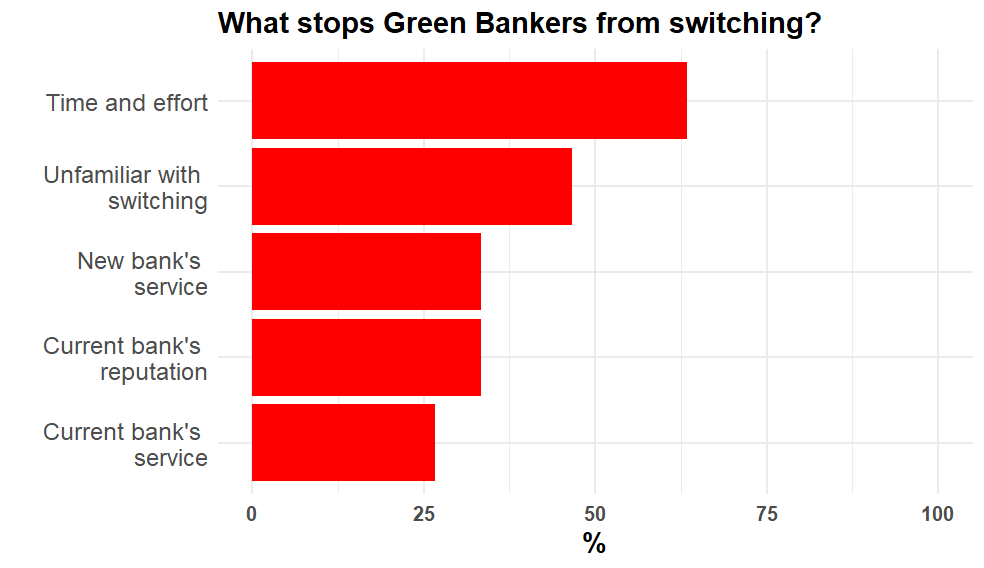
However, various things have stopped Green Bankers from switching. Only a minority (about 40%) have ever switched before, meaning switching is unknown territory for most. There are some practical obstacles, too: nearly two-thirds of Green Bankers who’ve thought about switching banks have been put off thinking it involves lots of time and effort.
In addition, awareness levels are low. Many Green Bankers don’t think that banks contribute to climate change, or that switching can help the environment. This may be because people are generally disengaged from banking, and haven’t learnt about banks’ links to fossil fuel companies. But without this knowledge, even if you persuade people to switch, they might not choose a green bank over a bad one.
On the other hand, Green Bankers have most often been encouraged to switch by good service quality and interest rates at a new bank (even though they’re happy to sacrifice returns).
Overall, the things that decide whether Green Bankers switch banks are quite like those that influence other customers – and sustainability isn’t a top concern. So, when encouraging people to change their bank we need to:
- Demonstrate that switching is easy, and that green banks offer good service and financial returns
- Persuade people that switching to green banks really does benefit the environment (but this shouldn’t be the focus).
Customer satisfaction surveys suggest green banks like Monzo and Nationwide have point 1 covered. However, prospective customers still need to hear this.
Lights, camera, (climate) action
Next, we compared two short films that encourage people to switch banks. This kind of film can be shared on social media to reach a large audience.
The first film we made ourselves. It shows an ordinary person switching to a green bank on her computer, and reflecting on why she wanted to switch and how quick switching was. The film is based on psychological theory and our first study: it tackles the practical side of switching, encouraging viewers to ‘copy’ the person shown and switch themselves.
A film similar to the one we made is here.
The second film was made by the campaign Make My Money Matter. It uses celebrity actors and comedy to argue that banks cause climate change by lending to fossil fuel companies.
Both films worked, increasing how much viewers intend to switch to a green bank, and by similar amounts. Our film succeeded mainly because it persuaded people that switching doesn’t require lots of time and effort, and the Make My Money Matter film by making the case that banks cause climate change so well. As expected, the more people were concerned about climate change, the more they wanted to switch.
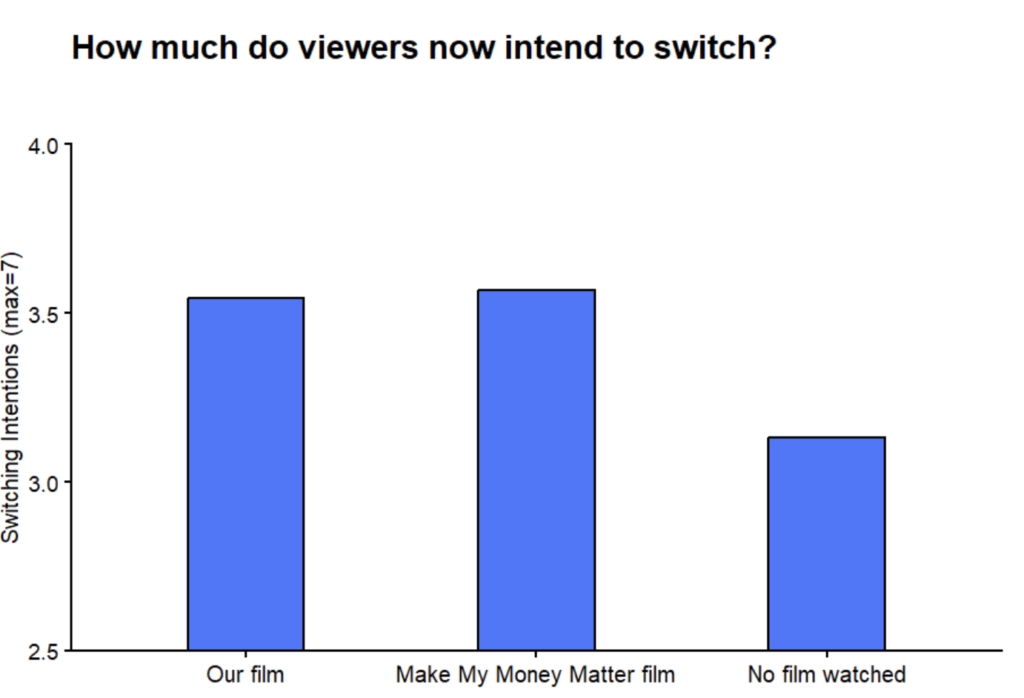
Our film changing ideas about the hassle of switching was encouraging, given how often it stops people changing banks. This suggests the power of seeing someone else switch to persuade people that switching is something they could do themselves, and in the process make them want to switch too.
However, neither film persuaded people that switching really helps the environment. Viewers might have thought individual people are too small to make a difference – so the idea of many of us switching together could be key for future films.
Reaching the public
Overall, lots of people are interested in switching. While there are barriers that currently stop people from doing so, films can deal with these and make people want to change banks.
What remains to be seen is whether people will actually switch to a green bank having seen a film. They might be more likely to if they watch multiple films, so they have more of a chance to think about the message. Green social media influencers might also get people switching by making films for their climate-conscious, persuadable audiences.
That said, films like ours can be made by anyone with a smartphone and a free video editing app. If you want to put some pressure on finance – and tell your friends and followers how great switching is – it takes 30-60 minutes. Please give it a go!
Further action
To hear more about this research, or talk about making your own switching film, please contact Samuel Price at samuel.price@bristol.ac.uk or +447876 803035.

Samuel will also be speaking about this topic at our upcoming Savings for the planet event on Tuesday 10th November. Find out more information and book tickets here.
References
¹ Source: The Guardian (https://www.theguardian.com/environment/2025/apr/22/89-percent-project-climate-change)
² Applies to UK customers. Source: Current Account with Service (https://www.currentaccountswitch.co.uk/news-insights/switching-data/current-account-switch-service-records-over-one-million-switches-in-2025/)
³ For example, compare Nationwide’s rates (https://www.nationwide.co.uk/savings/compare-savings-accounts-and-isas/) to HSBC’s (https://www.hsbc.co.uk/savings/interest-rates/)