Listen to 1000 Better Stories on your favourite podcast app or here.
What happens when two organisations with different backgrounds and areas of expertise learn to work together? How do we begin to connect the dots between health inequalities and the impacts of climate change? And how do we prepare to work alongside communities without arriving with all the answers?
The first two episodes of Becoming Unbound explored how communities in East Haven and Shotts are already coming together around health and climate. This time we are turning the microphone around to listen to a story from the Unbound team itself. Unbound brings together two organisations, the Scottish Communities Climate Action Network (SCCAN), and the Scottish Community Development Centre (SCDC). They both work alongside communities, but bring different perspectives to the project. SCCAN’s focus on climate action and SCDC’s on health inequalities.
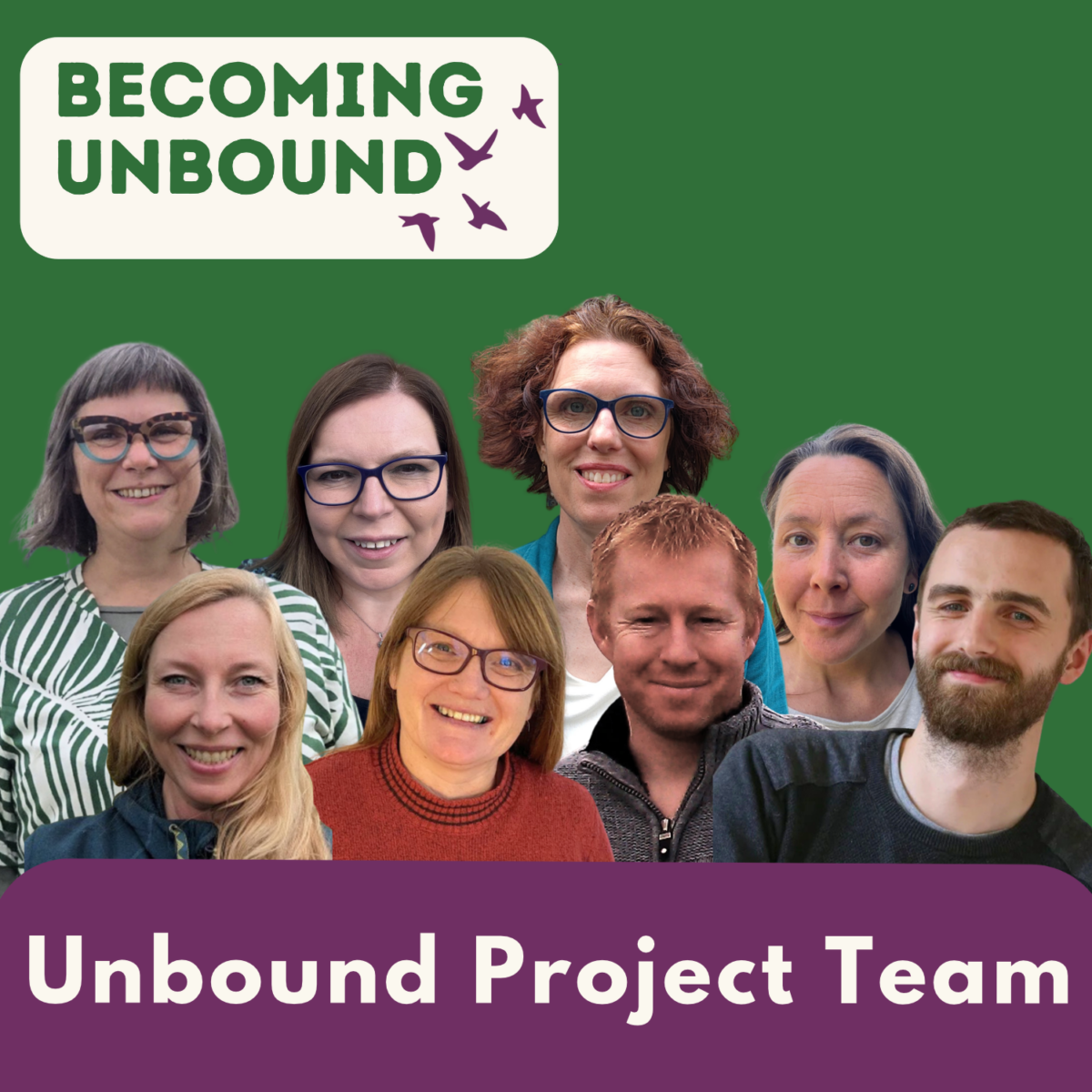
In this episode, you’ll hear from Dawn Brown and Craig Dunn, who coordinate the project, Laura McDonald and Kirsty Heron from the engagement team, Kaska Hempel and Alette Willis, who work on storytelling, and Sam Jordan and Ruth Mclaren from the communications team. Together, the team reflects on the first year of working on Unbound.
Becoming Unbound is the pilot podcast mini-series for the Unbound Scotland project, which supports community-led action on climate and health across Scotland.
Through conversations rooted in lived experience, the series explores how communities are responding to climate and health challenges – and how these stories can help shape the future of Unbound.
Unbound project is funded by the National Lottery Community Fund.
Chapters
01:04 Host introduction
03:17 The origin of Unbound
08:11 One day that sums up the first year of Unbound
19:50 The moment when something changed
35:40 What surprised us
50:56 What we learned this year
52:33 What seems possible now
53:45 Host reflection
Resources
Unbound Scotland project website: https://www.unbound.scot/
Scottish Communities Climate Action Network (SCCAN): https://sccan.scot/
Scottish Community Development Centre (SCDC): https://www.scdc.org.uk/
The Community Health Exchange (CHEX): https://www.chex.org.uk/
Credits
Kaska Hempel (design, production, interviewing, editing)
Blip Blop Tuesday by kjartan_abel — https://freesound.org/s/558270/ — License: Attribution 4.0
Transcript
CHAPTER 1: HOST INTRODUCTION
Kaska Hempel: Hi, it’s Kaska Hempel. I’m the story lead for the Unbound project, which supports communities across Scotland to take action on health and climate together. Let me introduce the third and final episode of our Becoming Unbound podcast pilot series.
Over the last two episodes, we’ve explored how communities in East Haven and Shotts are already coming together around health and climate. In fact, you might have heard my voice in the interviews with those communities.
This time we are turning the microphone around to listen to a story from our Unbound team itself. Unbound brings together two organisations, the Scottish Communities Climate Action Network, or SCCAN, and the Scottish Community Development Centre, or SCDC. We both work alongside communities, but we bring different perspectives to the project.
SCCAN’s focus on climate action and SCDC’s on health inequalities. In this episode, you’ll hear from Dawn and Craig, who coordinate the project, Laura and Kirsty from the engagement team, myself and Alette- we work on storytelling, and Sam and Ruth from the communications team.
Together we reflect on our first year of working on Unbound. It’s a story about learning to listen to each other and the communities we hope to work alongside over the next couple of years. We invite you to take a little time to sit with our story, to listen, reflect, and see what it opens up for you around questions we’ve been facing in our first year of work.
What happens when a new project emerges hoping to work alongside people in places like Shotts and East Haven?
What happens when two organisations with different backgrounds and areas of expertise learn to work together?
How do we begin to connect the dots between health inequalities and the impacts of climate change?
And how do we prepare to work alongside communities without arriving with all the answers?
CHAPTER 2: THE ORIGIN OF UNBOUND
[Multiple voices saying hello and chatting at an event]
[Craig’s speech at the first in person team meeting]
Craig Dunn: Thanks and welcome. It’s great to be here with everybody who’s working on the project. It’s especially great for me to meet everybody in person. I think I’ve met most people online. I’ve been asked to chat through the project, how it came about…
[Craig’s speech fades out]
Craig Dunn: Yeah, I can remember the exact moment when the concept of Unbound came into birth.
We weren’t as an organisation looking for this type of project, but as a little study, we were looking at where there was gaps in the community sector at the time.
I’m Craig Dunn, I’m Ops Lead at SCCAN Scottish Communities Climate Action Network.
I remember listing all the logos of all these organisations and trying to put it into some complex Venn diagram, and then at that point realising, oh, there is a gap here.
Health itself is well covered. I saw SCDC’s CHEX programme. So that was clearly covering health inequality already. But where I felt there was a gap was where that health inequality and climate action combined was missing.
In my view, backed up by a number of studies, climate change is gonna have the greatest impact on health going forward. I was just on a webinar talking about how many people suffered or even died due to the last round of heatwaves. So it’s gonna be at the forefront of lots of things.
What happens next is we start looking for partners to work on the project, and I made a couple of calls. Spoke to Dawn’s colleague, who seemed very interested. And both SCCAN and SCDC had some capacity for a large project, so it all fitted together quite nicely.
Dawn Brown: I think because I came in as a later member to the team, it was my colleague Sarah that had done a lot of the initial work, I managed to coast in after the hard work had been done. If we’re likening it to a birth, I’m post-midwife care. I’m the bit when the bonnie baby has arrived and get to look after the bonnie baby.
My name is Dawn Brown. I am Head of Programmes with the Scottish Community Development Centre.
From my point of view, following on from what you’ve just said there, Craig, I think the intersection between health and climate, when we look at all of the information, I think the people that are most impacted are the people that are already suffering numerous challenges in their life.
They will be suffering from the ongoing cost of living crisis. They will still be in recovery mode from COVID. There will be lots of people that have various different health challenges and income challenges in their households, and those are the people that are gonna be most impacted by both climate change and health.
And for me, that intersection between health and climate is where we are seeing so much community activism happening. So I think this project just pulled that together into something that wasn’t going to be wagging fingers. People get enough of a telling off about their carbon footprint, about all the things that they are doing wrong.
And for me, this was a really uplifting project, actually looking at how can we inspire communities to make those changes that are meaningful, that are sensible, that make sense to them. This was just that little perfect moment where that synchronicity happened, and we were really lucky that the climate funding was there through the National Lottery so we could pull all of this together into a project that will make a difference.
[Multiple voices chatting and laughing at an in person event]
Sarah Boath: Whenever I hear the words health inequalities, I just think inequalities.
I’m Sarah Boath. I’m Head of Programme at SCDC.
So I think, when you put a word like health or child or fuel in front of anything like inequality or poverty, we are talking about inequality. We are talking about poverty.
There’s really deeply unfair inequalities in health outcomes, which I don’t actually think as a wider society we’re fully aware of. It’s not just about life expectancy, it’s about healthy life expectancy. In Scotland, the gap has been widening over the last 10 and 15 years. I’m in my late 40s, and if I was living in the poorest communities in Scotland, I would’ve now exceeded my healthy life expectancy.
In the next 20 years of my life, I could expect to live in ill health, and that’s unfair and that’s wrong.
Craig Dunn: I don’t think there’s a single community that I could list that I could say is completely climate resilient given the changes that are already happening in communities in Scotland and are not too far down the road.
We’ve gotta do some stuff that just makes society itself a nicer place to be. Like making local food available, like making health services available, like making transport accessible. And all these pillars of society that are needed, if we can make them better, then that’s what we need to do to make a resilient community.
[Multiple voices chatting and laughing at an in person event]
CHAPTER 3: ONE DAY THAT SUMS UP THE FIRST YEAR OF UNBOUND
[Train announcement: We will shortly be arriving in Glasgow Queen Street, which will be our final stop]
[Several voices overlapping saying: One day that represents the year for me…, A single day that sums up the work we do…, One day that captures the whole year…]
[Train announcement: Glasgow Queen Street will be our next and final stop. ]
Kirsty Heron: Thinking about the engagement team, one day that stands out is when we met in person as a team in the SCDC offices in Glasgow, I think it was January, and we piled together all that we’d learned.
It felt exciting because we’re like, “Okay, we can see that these are the six areas where we’re gonna probably be working in the most where we’re gonna be able to give the most support, where we’re gonna put the most of our resources, where there’s highest health inequalities and most severe climate impact.”
My name’s Kirsty Heron. I work with SCCAN, particularly around doing training on things like resilience and climate communication. In the Unbound project, I work on the engagement and support team.
This represents the year for me in terms of before this we’d done a lot of work as a whole team, so that had involved all the different teams, but this was our first in-person meeting together as an engagement team, and it meant that we could really focus on the work that was coming up.
Laura McDonald: So the engagement and support team will mainly be site-based, working with communities. So we’ll be doing something within each council area in Scotland, building up the capacity of groups and organisations to take action around climate and health inequalities and to be involved in conversations around that.
I’m Laura McDonald. I’m a Development Manager of the Scottish Community Development Centre, and I’m one of the engagement and support team on the Unbound project.
So over the last year, we’ve been looking at what the data says about areas across Scotland, and then talking to agencies and community groups to identify where that extra support is both needed and wanted.
Kirsty Heron: We’d done a lot of our initial research. We’d done it online, and we’d been analysing data that we’d collected from a number of different sources around health inequalities and predicted climate impacts.
Health inequalities is about existing information. Climate impact is about what’s coming.
I think what felt good was that we could see the data, and it gave us clear indication of where to go next.
Laura McDonald: I think bringing all that information together as well, Kirsty, one of the things that kinda jumped out at me was that some of it had been familiar to me, for example, looking at flood risks when we support communities around local place plans. But SCCAN colleagues brought a whole load of other sources of data and information that I then had to go and look into for my areas, and I found that really brought different perspectives to the discussion.
So I could probably have written on a bit of paper the areas in relation to health inequalities that I thought were gonna come out higher. But what I found when we brought all that together was that combination of health and climate data didn’t necessarily give me those obvious patterns in some instances.
And I think that, for me, that kind of represented basically the whole year there’s been little bits of surprises that have come out by joining the two together.
[Zoom call ping sound]
Female voice 1: Sharing my screen…
Female voice 2: Do you see at the bottom of the page there?
Female voice 1: Yeah. Yeah.
[Voices fade out]
Sam Jordan: So in terms of the single day that sums up the work that we’re doing, I’m thinking maybe back to a session that we had a couple of months ago to discuss the type of work that we want to do around comms, but also doing a bit of forward planning. The chance, to get down on paper some of the stuff that we’ve been talking about for a while.
I’m Sam. I’m Sam Jordan from SCDC. I’m the Communications Manager there, and I also work in the communications team.
Ruth Mclaren: Yeah, so it was a kind of a morning session that was held online, ‘because we all work remotely, and it crossed both of our organisations, so SCDC and SCCAN were there, and Kaska was also there with the storytelling aspect.
So my name is Ruth. I work for SCCAN as their Communications Weaver, and I also work within the communications team for the Unbound project. Something I particularly loved, which was a bit of a light bulb moment, was the icebreaker that you’d given, Sam, which was very commsy: “What’s your favourite piece of content that you’ve worked on?”
And I was just really struck by the variety in everybody’s answers. Yeah, so Sam, your favourite piece of content was the community development in 60 seconds?
Sam Jordan: It’s like a web graphic thing. I guess that was like, how do we take this really complex thing and explain it in 60 seconds-ish, which is the type of thing that I like doing, making things as simple for my brain, which sometimes need things to be simplified.
So what was your favourite?
Ruth Mclaren: The series of posts for Scotland’s Climate Week that highlighted different aspects of things that SCCAN does. So it just meant that it was, like, inclusive to all the team which felt like a really nice campaign, and I’m very interested in social media, so I like the social media-heavy stuff.
And Madeleine, she’d chosen a social media post that she’d put together for Earth Day. Yeah, so Kaska brought a podcast called PLANT Voices, which is a podcast from Tayport Community Garden, which I believe was her first ever podcast.
Sam Jordan: Wow. Oh, there we go. There we go …
Ruth Mclaren: And Sheena, who is super analytical, her favourite thing was the CHEX Resource Hub.
Sam Jordan: Yeah, bringing together different aspects of SCDC’s work into a single place. She’s got librarian training, I believe, so I think there’s always that , that latent librarian, waiting just to come out.
Ruth Mclaren: That icebreaker was like, “Wow, this is really exciting.”
Sam Jordan: Yeah. I think hearing all of those different passions that people bring to their work and brought to that day it feels like that’s what we’ve been doing over the last year with Unbound.
We’ve been exploring aspects of different people’s work. In terms of communications it’s been really great to see that quite recently channel into stuff that we’re putting out there into podcasts, into blog posts, into images, trying to show that passion that we’ve got for these different areas of whether it’s health or climate or this new thing that we’re creating together as a comms piece around how health and climate work together.
[Road traffic]
Kaska Hempel: Hiya. Hi. Yes. Yes. I’ve just come up onto the main road from the station…
[Faint voice on the phone]
Kaska Hempel: I think I can see you. I can see you, I think. I’m walking towards you now. Yeah, no worries. See you soon….
[Road traffic]
Kaska Hempel: Hello. Nice to meet you.
Mags: Here you are! Oh.
Kaska Hempel: Oh, you’re a hugger, that’s great.
Mags: This is Sophie.
Kaska Hempel: Hello. .
Mags: I didn’t used to be a hugger …
[Voices fade out]
Kaska Hempel: It’s hard to choose one day that captures the whole year. But I wanted to share the day that I travelled to Shotts to interview Mags Murphy and Mark Slorence from Getting Better Together for one of our pilot episode stories.
My name is Kaska Hempel, and I’m a Story Weaver at SCCAN, and I produce the 1000 Better Stories podcast, and deliver audio storytelling training for communities. And over the last year, I’ve been the Story Lead for the Unbound project. My role is to help the Unbound team and the communities we work with to share their experiences through stories, showing the human dimension of this work.
It took absolute ages to organise. We had to find the communities which already worked across climate and health who we could learn from. There were lots of delays in finding people and finding organisations, and then getting sick and postponing things, so I was really super excited as well as super nervous about making it a good day.
So I got an early train from Dundee, and Mags very kindly offered to show me around the projects that the organisation’s been involved with across Shotts, and she met me at the station. And we were thankfully blessed with a beautiful day, beautiful weather. And I also met her guide dog, Sophie, which was a bit of a surprise to me, and I realised that she’s a major celebrity, getting all the pats and all the hellos, and she loved every bit of that.
And we of course had to stop every few minutes because it’s not only Sophie, but Mags had to chat with everybody. The strength of her connection to the community was such an obvious thing.
At the last minute, I decided to record this tour, which made for a very stressful time because I had to juggle microphones, traffic noise, and conversation. But it was really worth it because rather than just hearing about Shotts, you hear the Shotts that we visited.
And then I had a quick lunch at a community cafe, and then we settled down for a conversation with Mark in her office. We set up the recorders again, and of course, conversation lasted way longer than we expected because once people start telling their story they really wanna share so much. And once I start asking questions, I really wanna find out everything. But we stopped at two hours, more or less. Managed to wrap it up.
And on the journey home, I was super exhausted but, as always, super inspired by the people and the work they’re doing in their community. Also, I came away with much better practical understanding of what work around health inequalities really means, what it means in the community. I was listening to a lot of theory about it in our development sessions with SCDC, but this really brought it to life for me.
What this day really captures about the year and about Unbound, there’s this huge amount of unseen work behind this one day. Because we had to develop the podcast approach with the team, so that was a lot of work, discussions, research. It’s about working together. It’s also about starting with listening to communities and understanding what already exists, not arriving with answers. And it’s about bringing the ideas to life with stories as well, creating stories that connect people and keep conversations moving. So for me, that’s Unbound.
Alette Willis: I think what you said completely sums up Unbound. I wasn’t there with you on the day, but having helped out by being a sounding board for shaping the story that’s gone out as a podcast, I feel like I have a flavor of that day.
I’m Alette Willis. I am a SCCAN member. I’ve been very interested in stories and social change for, ooh, probably 25 years or so. I’ve been a volunteer with the Story Circle, which works very closely with the Unbound project.
It’s quite interesting to work on that pilot process because I can see this as a development of the particular culture of working with stories SCCAN has been doing, specifically as kind of a grassroots up organisation over the last few years.
CHAPTER 4: THE MOMENT WHEN SOMETHING CHANGED
[A group activity at an in person meeting, voice fading in]
Kirsty Heron: So we’ve got 10 minutes to find people who you’ve not had much communication with in this project so far, and you’re gonna have a minute each with them, and you’re gonna find out what you got in common with them. You’ve got one minute.
[Voice fading out]
[Overlapping voices: ”First day that things really felt as though they were changing…”, “ The moment when something really clicked into place for me…”,” One of the things that I had to unlearn a little bit…”]
[People chatting and laughing]
Dawn Brown: So for me, it was the planning day at the end of April. It doesn’t sound like everybody’s greatest moment as a planning day, but I just saw the two teams actually coming together as one unit, where we were mapping out what the community journey was gonna look and feel like. So we were able to host that day at the SCDC offices, which are in the middle of Glasgow, and I think nearly all of our colleagues were able to make it as well.
There was lots of shared planning, there was lots of discussion. We had some giggles. We always try and start with a little bit of fun, and I think for that one we used the Privilege Walk where people are given a scenario of who they are, and then a whole series of questions that actually allows them to think about what their internal privilege is, to think about our biases, to actually think about what are those judgments that we make as practitioners, as people every day.
That really stopped and made us think about the kind of people that we’re going to be working with in communities, and for me, that was a really strong moment just to make it real, to actually take it away from being a theoretical programme into what it’s gonna feel like for people in communities, and I think that gave us a really good grounding for the day.
From there, we went into a variety of different sessions, again, with the old community development stalwarts of flip charts and sticky notes and pens, where we did some shared planning, where we actually did a little bit of journey mapping to look at what is this going to look and feel like for communities.
But then also thinking about that legacy part of what is it gonna look like when we aren’t able to be there anymore, so that it’s not just a little bit of action while there’s support there, that this is something meaningful and lasting that they can keep on going after the Unbound project’s finished.
As always, for our shared events, there was lots of cake and biscuits. I think community development should go on cake, biscuits, and coffee. So there was lots of that. There was lots of laughter, and it just felt, for the first time for me, that we were really as one team.
It was really important being in person and having those softer discussions with each other, so it wasn’t all just focused on the work. Those over coffee break conversations when you learn about each other’s families and each other’s connections.
We’d gelled. We were there. We were just about to go to that bit about saying, “This is what we’re gonna be doing in communities.” And for me, that was just a super exciting moment to stop and reflect and to look back on the team building that we’d done and say, “Actually, tick that box. We have built a team. We’ve built a great team that will go forward and be able to do amazing work in communities together.”
Craig Dunn: I remember that day. I remember the end of the day. If you do good work, but it’s hard work, you’ve got that combination of fatigue, but you also feel enthused at the same time.
It’s a bit like if you have 20 people down the community farm or community garden all working on the same thing, putting up new raised beds or sorting a polytunnel. It’s hard, it’s physical. For us, it was mentally challenging on the day. So by the end of the day, I was pleased for the cakes and the refreshments to keep the energy up.
We just mirrored what communities do to stay together. Communities that are most resilient seem to be the communities that come together and eat and laugh dance and sing. And I’m pretty sure somebody sung at one point during that meeting. I had similar feelings about it.
You could sense before that day there was lots of questions. There was lots of people trying to find their feet. There was lots of people trying to find their direction and how they were gonna contribute to the project. And on that day, it felt to me there was lots of questions answered and lots of new questions.
So it was that, that welded the joints a bit. That’s what welded it together for me, was that day, and the fact that we spent that time together just exploring each other’s views, exploring how we were gonna make this project work,
[Sounds of the ferry arriving at a terminal, water sloshing, seagulls, human voices]
Laura McDonald: The first day that things really felt as if they were changing was the first day we actually went out into Inverclyde to start speaking to people in the area.
Kirsty Heron: Laura picked me up from the ferry. And so it was great to spend a few minutes chatting with each other about our lives and what we’re gonna do that day.
We had quite a packed schedule for two days, and we went around to loads of really interesting organisations doing amazing work.
Laura McDonald: That was the first day that I felt as if all that desk-based and online working was actually starting to mean something, and it was a mix of really starting to feel that we were going to be able to work with people in an area, as well as feeling that Kirsty and I were going to be able to work together.
We’re co-leading in Inverclyde, and partnership working isn’t always easy. You need the right gel of people for it to work really effectively. So as well as working in data and site identification, we’d also spent the year bringing the two organisations together and iron out a common approach as best we could, as well as upskilling each other.
But you can do as much of that as possible, and it’s not until you actually get out there and start working together that you know whether that’s going to work.
Kirsty Heron: What I really loved was hearing Laura talk about the project. I realised that just she’d embedded in her language so many of the conversations that we’ve been having over the past year, and it made it really clear to me that, we have a shared vision on this, that all that planning and skill sharing was emerging right there and then into this just very open, friendly, and passionate way of meeting people, talking about the project, listening to what people are already doing, and finding common ground with the activities they’re already doing.
Laura McDonald: By the end of our two days in Greenock I was happy that we were gonna work well together. I think that was probably the first day that I properly started thinking WE rather than US and THEM about SCCAN and SCDC.
Kirsty Heron: Before that, a lot of my meetings with partners and local organisations had been online, which is a practical way to organise lots of meetings.
But actually being in person, seeing where people work, walking around the town, popping into different buildings, walking along the seafront at lunchtime seeing the community gardens that people are working in, meeting some of the volunteers, that all really brought this to life because these are the people who we hope to be working with over the next year or so.
These are the people who already know loads of great stuff about where they live. These are the people who really have so much care and commitment to their communities. So that day was special and, yeah, really brought this to life for me.
Laura McDonald: We could see the potential for what the project could offer practically on the ground, not just written on a bit of paper and our ideas.
[Presenter’s voice at an in-person meeting]
Dawn Brown: So that by the end of the session, what we’re gonna have is hopefully a bit of a journey, bit of a road map through how we start to engage with communities, what that looks and feels like. It’s about all the folks in this room using their collective wisdom and knowledge of community engagement, our knowledge about health inequalities, our knowledge of climate.
So I want you to go away and grab some flip charts, Post-it notes, pens.
[Presenter’s voice fading out]
Sam Jordan: So one of the things that I have definitely had to unlearn a little bit, or to reframe my thinking is thinking about climate as this single blob, this single entity and thinking more intersectionally.
Now, I think about health like that all the time. That’s the bread and butter of health inequalities. It’s not just about health, it’s about all the things upstream and downstream and how health is part of everyone’s life. And I think about that really easily. So that has been a really helpful journey for me to understand climate in that sense.
And then from there, almost like transplant over some of those same thoughts that I have around health and health inequalities into a way that makes those two things kind of gel together. And that’s what we’re trying to do, climate and health together.
Ruth Mclaren: Yeah. I feel that way about in the opposite.
And also obviously, you know how directly health and climate are affected by each other. Obviously, you rationally know that, but I’ve been surprised at how siloed I feel like my brain works. But I guess because I spend so much time as an individual thinking about climate that is your main focus.
[Zoom call ping sound]
Kaska Hempel: Health warning, it’s gonna be an interactive workshop, so get yourself ready. Here is the outline of the session. Main thing I wanted to focus on is actually just having a go at the hosting and just seeing how that sits with everybody and whether that feels like a right decision for us in terms of the podcast.
[Voice fading out]
Kaska Hempel: The moment when something really clicked into place for me was that workshop with the Unbound team late last year. Alette, you were taking part in that. I think that was probably almost your first foray into working with the Unbound project. And we were together online with the Unbound team to test a new format for the podcast, where members of the project team would record conversations in response to the community interviews.
It was a bit of a practice because nobody’s actually done podcasting before, so we wanted to build up our confidence, but also get some feedback on the format. We were hoping that by listening together it would help us learn from communities already addressing climate impacts and health inequalities. And also it would create a space for people across two organisations to learn from each other. So there was multiple layers to this process.
But as we talked, it just didn’t quite feel right. I don’t know, you were there as well. I think because we found ourselves really analysing the interviews and pulling stories apart, and not really letting the stories shape our thinking. It felt particularly wrong because the community wasn’t there with us to add to this conversation. That’s when you brought in the idea of thinking with stories. Do you want to add anything to how you felt in that session?
Alette Willis: Just a reflection. I think that there’s a strong feeling of urgency around climate change in health, social inequalities that are expanding, and a desire to get at solutions.
And I think it’s this tugging towards trying to solve something that often pulls me into analysing stories, thinking about stories rather than thinking with stories. And that was perhaps part of what I was feeling was going on in that conversation. It’s just that we need to jump towards something that’s going to improve the situation.
And it can be a bit of a critique of thinking with stories is that it’s slower, you have less control over it, you have less control over how other people receive the stories than if you start analysing and pulling apart a story into bits that can be PowerPoint presentations and that sort of thing.
Kaska Hempel: And presenting them as lessons.
Alette Willis: Yeah. This is the lesson, this is the solution, this is the steps that then the next community can take. We can distill these.
And the idea of thinking with stories comes from narrative therapy, but it’s also been used quite a bit in looking at healthcare as being too expert driven and that there’s actually a lot to be learned by sharing stories rather than sharing the solutions.
And part of that is the idea that when we hear a detailed story, we can imagine ourselves into that situation, and we are able then to reflect back on our own experiences in a less controlled but in many ways more direct way than if we had an intermediary presenting us with… bullet points are not necessarily the easiest way to imagine how to work through a very specific and concrete situation.
They’re great for policymaking, because policymaking needs to be very general and to apply everywhere in ways that are helpful. So that’s excellent use of analysing stories to develop policy that can apply everywhere. But if you want to give something to someone or to a community to help them creatively think their way through the multiple problems that they’re facing today and may face in the future, actually a detailed story about what another community has done, even if that community seems on the surface to be completely different, can be a more valuable tool.
So thinking with stories means actually focusing on your reception of the story, how that connects to your past experiences, to your feelings and to the problems that are currently on top, if you like, for you or your community.
So we often talk about resonating. So if you hear a story, what resonates with you and your experience? What grabbed your attention? Why did that grab your attention? How does that thing that grabbed your attention connect to your experience, your particular problem, your particular puzzle that you’re trying to work out?
Kaska Hempel: Amazing explanation. I have a one-sentence summary: “Thinking with stories is about listening deeply to people’s experiences and allowing their stories to challenge, connect, and transform the way we think, rather than reducing them to lessons or evidence.”
Alette Willis: Love it! Yeah. I think that’s a perfect summary.
Kaska Hempel: So that simple shift in how we thought about host conversations had a really important impact on how we think about stories, not just in our host conversations, but I think it’s also been shaping the way that I’ve been thinking about the community story work in Unbound, and it’s not a finished idea, but obviously host conversations is one thing. But I’m trying to work with the team and myself to learn to think with stories more.
CHAPTER 5: WHAT SURPRISED US
[Presenter’s voice from an in person meeting]
Rebecca: You might have heard me say this before, but I’ll just say it again because it is quite important to understand. So we do not have the predictive data that we need- … in Scotland, and this is well understood. It took me a long time to realise that everyone understood this.
[Overlapping voices: The thing that surprised me most from the project…, The pleasant surprise for me was… There’s been no nasty surprises…]
[Presenter’s voice from an in person meeting continues]
Rebecca: … so there are two datasets that give us some idea of what’s gonna happen in the future, and heat wave was one of them, and drought was one of them. But that…
[Voice fading out]
Dawn Brown: The thing that surprised me most from the project was how little data there actually is out there when we were looking at the impact of climate on our communities.
For it being such a high-profile thing that’s in the news so often, I thought there was gonna be so much more information there, and there was just so many gaps. The climate emergency isn’t something new. It’s not something that’s just sneaked up on us. And for me, those gaps in the data felt really stark.
It felt really scary.
Craig Dunn: I think the most surprising thing is how we’ve adapted to each other’s knowledge. I can remember a specific moment looking across the table to our colleagues in SCDC, and in particular, I think it was Susan, when SCCAN was presenting the climate hard facts at the time.
And I could see a bit of surprise in her face, even though the knowledge within SCDC on climate was much higher than I had anticipated, so there was still surprise around the table at the data.
I’m just off watching another webinar where I didn’t know that 40 houses burned to the ground in the UK last year due to wildfires. That’s a fact I didn’t know. It’s not been in the news, and I feel like I’m inundated with climate facts. I feel like I could just reel them off like that, one, two, three, if anybody asked them. So yeah, it was great to see the SCCAN team take on board the SCDC’s presentation on health inequality, and then it was equally great to see people willing on SCDC’s side to take on board the pace of change of the climate as it currently is.
Dawn Brown: I think the other thing that really surprised me was how well and how quickly the teams have come together as Team Unbound. We’ve got two organisations that have different structures, different ways of working, and different focuses. But for this project, we’ve actually pulled together really well into this Team Unbound.
People have been really open to sharing their knowledge, to sharing their skills, but also to being influenced and shaped by other people’s practice. And for me, that’s just been such a super place for us to be as a team. It’s been surprising, exciting to see just how well that’s all come together.
[Presenter’s voice from an in-person meeting fading in]
Dawn Brown: When you talk about community development, like everybody is on the same page and goes, “Yeah, I know what community development is.” So community development is actually a process where people come together to take action on what matters to them. It’s about putting people at the heart of everyone having access to health, to wealth, to wellbeing, to justice, to opportunities.
For me, community development is actually a radical practice. It is a really radical practice to look at how do we get to inequalities at their root…
[Presenter’s voice fading out]
Ruth Mclaren: I had no expectations, actually. And I think something that’s been really good about Unbound is that there’s been this time at the start built in before delivery begins, where, as someone from SCCAN, we’ve had time to get to know SCDC, and I’ve been able to get a little bit more comfortable with health and talking about health rather than just entirely being focused on climate.
So it’s not that there haven’t been surprises, it’s more that I just didn’t have too many expectations for myself to be in a position where I might be surprised. But I think it’s good. There’s been no nasty surprises.
Sam Jordan: Yeah. I’d agree with that. It doesn’t feel like there’s surprises, but I think working together actually has allowed us to really smooth out some of those areas where it might be a bit of jolt to the system, and I think that’s only gonna continue as we, as a team, start going into an area which is quite new.
Health and climate, there is a lot of stuff out there already, but really in the context around community-led approaches, having surprises is the point. Now, that’s the whole point of community development. You don’t know what’s gonna happen when you go in there. You don’t know necessarily what communities are gonna say, and I think we’re set up well to deal with those surprises is what it feels like.
Ruth Mclaren: I think the surprises are not for the year that’s been. I think the surprises are ahead of us.
Sam Jordan: I think that reflects the type of work that we do as well through comms. We are about responding. I think for us, that natural place is to be hearing what other people are saying and understanding their perspectives, and I think that’s where, as Ruth says, over the next couple of years we’re gonna be having the opportunity to learn from communities, relish having that come at you and being able to say, “Brilliant, let’s take this on, and let’s understand what people are saying.”
And then from there we can turn it into something that’s learning that helps other people understand some of these big issues around climate and health.
[Voices at an online meeting fading in]
Kaska Hempel: Recording now.
Pam Candea: Is my sound okay? Because I forgot my little external speaker.
Kaska Hempel: No, this is great.
Pam Candea: Okay.
Kaska Hempel: This is fantastic.
Pam Candea: And Kaska are we going through the questions, or are you going to prompt us with the questions?
Kaska Hempel: Okay. Good question. So…
[Voices fading out]
Alette Willis: In doing that pilot process with you, I think what did surprise me was really getting into the nitty-gritty of how stories as case studies get used and understood by different organisations, even though I used to work in the School of Health and Social Science, and I’m quite aware of the different ways of working with stories and narrative within the health field as well as within the environmental field.
It was quite an interesting opportunity to see that live in action, the coming together, not just of stories, but of approaches to stories and storytelling.
Kaska Hempel: I’ve never worked within community development and health inequalities, and over the last year I’ve been learning a lot about that work from our partners.
And the pleasant surprise for me was how much of this work deeply relies on storytelling and foregrounding community voices and lived experience, because that sort of chimed with the work I’ve been doing with SCCAN.
And I was glad to see that there were overlaps there and the idea that sharing people’s stories, rather than facts and figures, which in climate tended to be the default, look at science, look at the information. But we moved away from that now, and we now use stories to make complex issues such as climate easier to relate to and more real for everyone, and easier to imagine taking action on as well.
Alette Willis: Yeah. I think in the Unbound project, when you’re talking about communities and working with and from a community perspective, it really has to be about stories, and I think that’s where the overlap is between the different fields.
So I think what really interested me was the first time that we tried one of these host convos… Actually, before that, the first workshop that we did… was how differently organisations that work with communities on the big crises we’re facing- climate change, inequalities -how different organisations work with story.
On the surface we might think we’re all approaching our work in the same way. If you say the word “story”, we think we’re all thinking about the same thing, but we’re not. Because every organisation develops its own culture over time, and that’s driven by who that organisation works with, whether it’s the research community, the practitioner community, the government, the people that we’re working on behalf of, the people who we’re working with.
I think SCCAN has developed as a network of community organisations and that has led to an approach to story that is maybe closer to the ground as well. Also, the people who’ve been involved in this, the SCCAN Story Circle have come from creative arts kind of backgrounds, with podcasting, fiction writing, performance storytelling, and so the idea about story and the power of story in and of itself has been part of the culture of the Story Circle at SCCAN.
The story is the message.
Whereas I’m not part of SCDC, and I don’t know the organisation as well, but they seem to have more of an orientation towards policy making and speaking to policy makers, and policy may be less interested in story in itself and more interested in the lessons that can be learned from stories that then can be applied more universally.
So it’s not the story as the message as much as what is the message in the story.
I think public health often tries to scale up individual stories into that broader social narrative, whereas SCCAN has been more of a network where you share your stories between each other…
Kaska Hempel: You learn from each other’s stories.
Alette Willis: … and learn from each other’s stories, and don’t need to come up with something that will be applied to everybody.
And I think that bringing something like that in the open is a useful learning when two organisations are coming together for the first time to work on a project. It’s that almost obvious thing that we never really consider, which is when we use words , we often referring to something completely different with exactly the same word.
Kaska Hempel: And it makes sense. Both of these approaches make sense in the context. I think reconciling them and making sure we capitalise on them in different ways is important in this project. And I think just the recognising that these differences are there is an important starting point.
Alette Willis: Yeah.
Kaska Hempel: And I’m really glad that approaches in community development are so well-documented. It’s such a mature field. And there’s so many toolkits.
So I’ve been exploring all the different ways of sharing people’s lived experiences in a way that’s sensitive and allows them to control the shape of the story and making sure lots of different voices are heard.
So I’m really looking forward to combining the approaches together, so it’s interesting that you’re finding there are definitely differences. But I think it will be quite nice to merge our ways of working about the statistical stuff.
[Presenter’s voice at an in person meeting]
Female voice 3: The phase two was all about meeting local strategic partners and health, the voluntary sector organisations like TSIs and climate hubs and councils within sustainability and community planning or empowerment or community learning development teams within the councils to get a steer on what’s already getting invested in the area, what’s already happening in the area. Find out a little bit about where they think there could be communities that could benefit from a little bit of Unbound support, either in climate or in health or bringing them together.
[Presenter’s voice fading out]
Laura McDonald: The biggest surprise for me over the last year or so was when we started talking to agencies and organisations and how when we said the project was about climate and health inequalities, the word climate being in the mix generally resulted in us being steered towards climate groups or work that limited climate and health around things like active travel being good for your health and good for the planet.
And generally, people weren’t connecting the fact that as the climate is changing, people impacted by poverty and poor health are going to be much more vulnerable. And as a result of that, we’re developing a short explainer video that can be used both with communities and practitioners around how the effects of the changing climate won’t impact everyone equally.
I assumed when we said health inequalities that people would make that switch in their heads. And it surprised me that actually there’s a little bit of work that’s having to be done right at the start just to explain the whys of this project and why it’s so important and how it differs maybe from what people assume we’re going to be doing because we say climate and health.
Kirsty Heron: It’s part of that building awareness around what climate impacts will mean and how communities need to be coming together to build that resilience now. When we talk about climate, it’s not just about reducing carbon. It is about adapting, getting ready, and yeah, and working together, and that there can be positive benefits to that.
We’re trying to do this in a way that isn’t making people feel scared about what’s coming. It’s about opening eyes and building those relationships and networks that we think will be some of the most solid things as the climate breaks down and throws up more and more challenges for people.
Laura McDonald: It probably surprised me because we had been immersed in this as well. And we’d been learning from each other around how those two things are interacting and impacting with each other for quite some time. If I take myself back to the very beginning of the project, I wouldn’t then have been surprised about the direction that other people’s heads automatically moved in when I said climate and health. We’re so committed to what the project is and what it’s trying to change.
Kirsty Heron: That’s one of the really great outcomes of this work, isn’t it? That kind of meshing of our organisations and the learning we’ve been doing together.
SCDC, your organisation, the learning that you’re doing around climate resilience and it will be feeding into your work with communities. What we’ve been learning from you about health inequalities is feeding into the dialogue that we’re able to have with with our members as well.
So yeah, there’s a lot of fruit from this work.
CHAPTER 6: WHAT WE LEARNED THIS YEAR
[Overlapping voices: This year taught me…]
Ruth Mclaren: The potential in collaboration.
Kirsty Heron: That partnership working is really interesting, and that it’s challenging. But what emerges is just something more than the sum of its parts, and I’ve just got a whole new set of colleagues that I didn’t realise that I would have a year ago.
Dawn Brown: That I actually know more about the climate than I gave myself credit for. Also, that I have a lot to learn. It’s really exciting to be learning again. I love that way that we’re learning from each other, and just that passion that people bring to it.
Craig Dunn: I’ve learned that the knowledge of what’s happening with our climate isn’t there at policy level.
But it is starting to get through.
Alette Willis: That there are lots of creative ways that we can work with stories.
Dawn Brown: To trust stories a bit more as not something to analyse, but a way to understand what really matters to people, and how change actually happens.
Sam Jordan: The value of that slightly cheesy, but thinking outside the box a little bit, and that’s kind of what Unbound’s about, isn’t it? It’s about thinking about things in different ways and new ways.
Laura McDonald: To think differently about the climate. About looking at what’s gonna change now anyway. It’s not about giving up on doing things that can help make things better for future generations, but it’s also about recognising that we’re now at the point where some changes are locked in, and that we need to start planning for how we protect the most vulnerable in our society.
CHAPTER 7: WHAT SEEMS POSSIBLE NOW
[Podcast theme music starting]
Ruth Mclaren: What feels possible now is…
… big things.
Alette Willis: …that we can continue to innovate in working with stories.
Sam Jordan: …that we’ve the structure in place to take on what is a pretty big communications challenge.
Kaska Hempel: …is using stories to bring communities and our organisations into better conversations, where listening to lived experience helps to think differently.
Craig Dunn: …a successful project based on real facts that climate change and health inequality is now in the news. It’s the forefront of many news stories and it’s on a daily basis.
Laura McDonald: …is working with communities to help them have some agency in that, to look at what needs to happen in their community to reduce those risks and impact.
Dawn Brown: …that we can be inspired by our communities.
Kirsty Heron: …is to meet the challenges of this moment with the combined strength of each organisation to support communities where they tell us they need it.
[Podcast theme music rising and then fading out]
CHAPTER 8: HOST REFLECTION
Kaska Hempel: Hope you’ve enjoyed getting to know us and finding out a little more about Unbound. It’s hard to believe it’s been over a year since we started working together on this project. We are now at a very exciting stage where our engagement team are talking to the communities on the ground, exploring what matters to them and what kind of support they might need.
Over the next couple of years, we’ll be working alongside these communities and bringing you more Becoming Unbound stories. Stories about what happens when communities have the space, relationships, and support to think differently about the connections between climate impacts and health inequalities, and what becomes possible when we start exploring those connections together and thinking outside the box.