
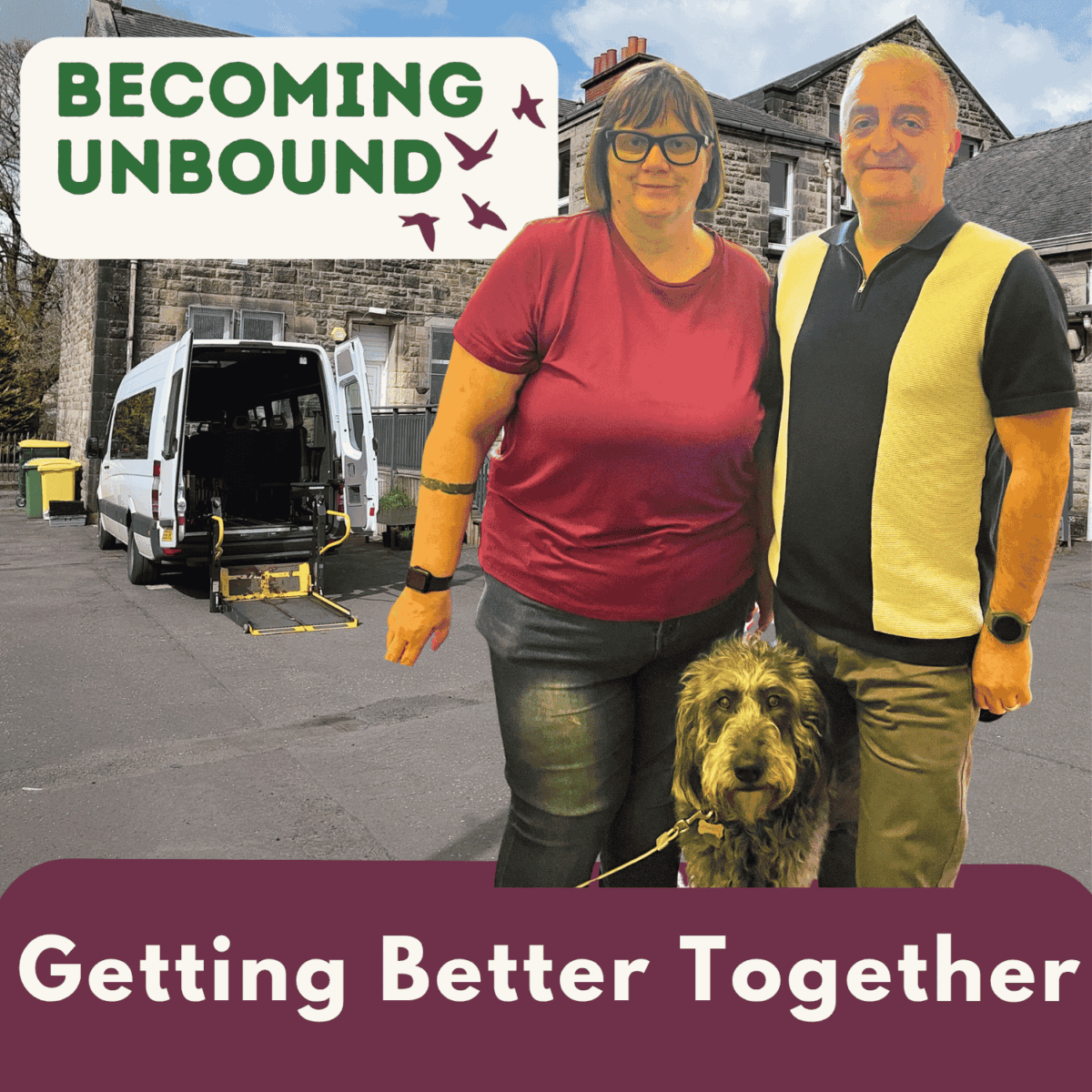
Listen to 1000 Better Stories on your favourite podcast app or here.
What does it mean to live well? And what does it take for a community to make it happen in the face of disappearing jobs, increased cost of living and a changing climate?
Join Kaska Hempel, our Story Lead, as she visits Shotts in North Lanarkshire to meet Mags Murphy and Mark Slorance from Getting Better Together, one of Scotland’s innovative Healthy Living Centres. Together they explore how their community has led for 25 years on helping local people live well – building better health and, more recently, weaving climate action into everyday community life.
Hosts Laura McDonald (Scottish Community Development Centre) and Pam Candea (Scottish Communities Climate Action Network) reflect on the story, exploring how communities can improve health and wellbeing while creating a more resilient future, and what Unbound can learn from places where climate action grows naturally from the things that matter most to people.
Becoming Unbound is the pilot podcast mini-series for the Unbound Scotland project, which supports community-led action on climate and health across Scotland.
Through conversations rooted in lived experience, the series explores how communities are responding to climate and health challenges – and how these stories can help shape the future of Unbound.
Chapters
00:40 Host Introduction
02:25 Welcome to Shotts
11:39 Something Had to Change
16:38 Making Things Happen
21:34 More Space for the Community
24:11 Living Well
30:01 When the Weather Changes
33:45 Building Resilience
39:01 Keep the Wheel Turning
44:13 Host Reflection: The Story Beyond Shotts
Resources
Unbound Scotland project website: https://www.unbound.scot/
Getting Better Together website: https://shottshealthyliving.com/
The Community Health Exchange (CHEX): https://www.chex.org.uk/
Healthy Living Centres – the origin story and long-term survival through Healthy Living Centre Alliance: https://www.seemescotland.org/media/7290/one-vision.pdf
Scottish Communities for Health and Wellbeing – An alliance of community led health organisations dedicated to promoting and delivering health improvements and reducing health inequalities in Scotland’s communities: https://www.schw.co.uk/
Health Issues in the Community resource: www.hiic.org.uk
Shotts Climate Plan: https://shottshealthyliving.com/downloads/Shotts_Community_Climate_Action_Plan_20.05.22.pdf
Story of how Shotts Climate Plan came together:
https://www.keepscotlandbeautiful.org/blog/2022/shotts-is-acting-now-on-climate-change
Environmental Key Fund: https://environmentalkeyfund.com/
Info on Community Benefit Funds: https://www.gov.scot/news/communities-benefit-from-renewable-energy/
Investing in Communities Fund
https://www.gov.scot/publications/investing-in-communities-fund-round-2-approved-awards-2023-2026
Credits
Kaska Hempel (design, production, community interview, editing)
Blip Blop Tuesday by kjartan_abel — https://freesound.org/s/558270/ — License: Attribution 4.0
Transcript
Host introduction
Laura: Hi, I’m Laura McDonald. I’m one of the Development Managers at Scottish Community Development Centre, and my work takes me across Scotland. We do have a Glasgow office, but today I’m joining from Argyll and Bute.
Pam Candea: And I’m Pam Candea, one of the engagement team at SCCAN, and I’m joining from Stirling.
Laura: We’re both part of the community engagement team at Unbound, which is a project exploring how action on climate and health can help communities across Scotland thrive.
Pam Candea: And in this podcast miniseries, we’re listening to stories from places around Scotland, taking a bit of time to sit alongside them rather than explaining the stories, and seeing what they can teach us about climate, health, and collective action.
Laura: Yeah, and about paying attention to what people are already doing in their local areas as we shape our own work on Unbound.
So Pam, where are we heading today?
Pam Candea: Today we’re off to Shotts in North Lanarkshire.
Laura: Shotts is one of those places that lots of people have passed through on the train between Glasgow and Edinburgh, but maybe don’t know very much about.
Pam Candea: Yeah, it’s got a strong industrial history. It was once known as a town built on coal and iron.
Laura: So who did our Unbound storyteller, Kaska, meet there?
Pam Candea: She went to meet Margaret Murphy, who everyone calls Mags, and Mark Slorance from Getting Better Together.
Laura: Before sitting down together in the office of their main bui lding, Mags, together with her guide dog, Sophie, took Kaska out on a tour of some of their climate and community projects.
Pam Candea: That sounds like a really good way to get a feel for the place before diving into the interview.
Laura: Exactly. And you’ll hear little excerpts from that tour woven through the conversation.
Pam Candea: So I understand the tour started at Springhill, where Getting Better Together have recently taken on a plot of land and built a new community hub.
Tour of Springhill
Mags Murphy: Thank you. Okay. That’s us. We’re just going up this way. [to Sophie: Sophie, come, wait.] It’s a lovely area, I think, when you come into Shotts it’s nice. There’s a lot of greenery around about you and that as well, sometimes you see the cows over there. A farmer has the cows out and that as well. So there is a lot of greener area around.
That is, as you can see, the golf course over there. You can see right down to Airlington and that there. There’s pits over here as well, so we were surrounded with pits at one point. The ironworks came first, believe it or not. And then the pits came for to feed the ironworks. So the ironworks was a big area.
It was huge. We’re a prime area for wind farms the way the wind is. So I think we’re a prime area here we’re higher up as well. So we’ve got quite a few wind farms round about us. We do get money back from it. Here. There’s the Environmental Key Fund.
They were involved with us with this because obviously we had to get different pots of funding to do it. So they were part of it as well, and North Lanarkshire Council, The Lottery. So it’s a big area … that we took on. We’d just made the decision to take the full lot on. So we now own it. [laughter]
Yep, why not?
Interview
Mags Murphy: I’m Mags Murphy. So I’ve been here from the very start.
I was Chair at one point. I am now employed, so I’m no longer on the board, but I am the Adult Services Practitioner Financial Wellbeing, and I also do volunteer at Listen Lanarkshire Radio where I’m a DJ.
Mark Slorence: And I’m Mark Slorence. I’m the current Executive Manager here at GBT. I joined Getting Better Together in 2018, where I brought over our hospital discharge support programme to Getting Better Together.
And then in 2021, I took over from June, who was the previous Executive Manager.
Kaska Hempel: Can you tell me a little bit more about Shotts and this area, in North Lanarkshire, ?
Mags Murphy: If you take a walk around about Shotts you will see areas
where there is a deprivation there and poverty there. And when Getting Better Together started up, that was one of the things we were looking at, and how can we improve that. We were villages to start with so we were Dykehead, Springhill, Stanton, Bothogil was the areas. The population’s still under 10,000, which is not a bad size.
We do have unemployment obviously. Unfortunately, work within the actual town has dwindled down over the years. We have difficulties getting to it sometimes our public transport’s not the best. You may be able to get out to it, but it’s trying to get back in at night. And we do have a train line, but unfortunately a lot of people here maybe work at Wishaw that way, or Livingston going that way now.
If you’ve got a car, you have great links we’re right off the motorway at junction five. So if you’ve got a car, you can be in Glasgow for 25 minutes, 30 minutes, and the same with Edinburgh and that as well.
Mark Slorence: There was a lot of new houses being built. And it’s maybe been seen now as a more of a commuter town.
. So there’s a lot of younger people that are able to commute. And so just as Mags has said, that the Shotts and the surrounding areas are classed as an area of rural deprivation, so, hence why Mags is so busy, I think, you know, particularly within her role as a Financial Wellbeing Advisor.
Kaska Hempel: So – lots of challenges. But would you share a fact that people that are not from around here might not know?
Mags Murphy: As a teenager everybody that I knew was working. All the parents working, my brother and my sister, and it was all local work as well.
People would say, “Oh, you could leave school one day, start work the next day.” Literally in Shotts you could do that at one point because the work was there. We also had lots of shops, two cinemas. The miners got together, and they put money away each week, and they built the first swimming pool that was here in the area.
They wanted local people and local kids to be able to go and learn how to swim. As a teenager growing up here there was things that you could do. There was discos on for us. There was youth clubs on. There was the Scouts, the Brownies, there was the Girl Guides, the Boys Brigade, different football clubs and that as well in there.
I’m talking about the ’70s, coming up into the ’80s. You still had all that going on. Which you don’t have now.
Mark Slorence: Just following on a wee bit from what Margaret’s saying about the things that used to be here. We are starting to bring some of that back. Not us directly, but we support other projects, like Spotlight Shotts, who are bringing the use of the Henderson Theater back, so they’re bringing the arts and theater back into Shotts. We’ve also recently been supporting Shotts Bon Accord, the football club over at Hanna Park. We’re funding to get the facilities … up to speed for the actual local team itself, but also for the community engagement.
Kaska Hempel: Do you have a favourite place, a favourite thing about Shotts , that you can tell our listeners about?
Mags Murphy: I think we still have people looking out for each other, community spirit. We still have that. We still have our Gala Day every year, which the last couple of years they’ve had a big stage there.
It’s in the park, and local people have been able to go on and, do dancing, singing, whatever, and that’s been good, that gets the full community together. So I like that something for the kids to do that day. It’s local.
As a child we all walked to Gala Day, with the school. And I was always proud to be walking in it, and family members shouting out to you and waving to you and that, and you get your bag at the end of it, with your treats and that in it.
There still is a parade. We still have a queen. We have a court. Some people put loads of work in to do the houses up. And you see the parade coming down, and there’s floats and that and, just fun. It’s all fun.
Mark Slorence: So favourite place…
Mags Murphy: Here!
Mark Slorence: Same! I just see the four walls of my office most of the time. No not really. I suppose I would probably need to say the Springhill Community Hub, obviously taking over from June just at the time of the community asset transfer. Overseeing the development of the site. That community spirit as well, you know, community of Springhill have taken some ownership. Yes you still get some bad ones that like to do their own graffiti and a wee bit of damage. But what you’re finding is the community are keeping an eye out and reporting things.
But closer to hand would be the community garden. It is nice to go up, if I get a chance when the sun’s out to get a bit of peace and quiet up there. But it’s a great space.
Springhill tour
Mags Murphy: This whole area we own all of it. It’s getting done in stages. Obviously the first stage was the building. Originally the building was there and
what it was just a what we called the old man’s hut. It was a wooden hut with a hall in it, a kitchen, and toilets. We knocked the hut down because we couldn’t do nothing with it. So we put flower beds there. So that’s originally where the old hut was. We made this play park here. That’s a pump track.
We asked people what they wanted up here. We did a survey. We had people coming into the hall. We had different ideas down. We asked them to pick. We asked them to put ideas down as well, what they would like,
and people came with the pump track, and they said about an outdoor gym as well … and walkways. So this area’s still all getting developed. There’s going to be wildflowers and all this planted as well. We’ve put the trees in. There’s a play area for the kids. Wee bit here. We have got lights that come on at night as well.
This is the newest bit of it that we’re coming to. So people’ve asked for an outdoor gym There’s loads of different equipment there if you wanted to use it.
Interview
Kaska Hempel: So can you tell me what Getting Better Together does? I believe that’s quite a lot.
Mark Slorence: So Getting Better Together, we’re still classed as what we call a Healthy Living Centre, and we’re also a development trust for the local area.
And when we say Healthy Living Centre, that’s really providing support to local community, and as they describe it from cradle to grave. And within that, we run multiple programmes so much so that we’ve created departments within the organisation. For instance, we have an early years and youth department.
We have our Get Active, Get Going department, community transport, the community cafe, our adult support services. We have a hospital discharge support programme, the radio station.
And we also facilitate the visitor centre over at HMP Shotts, so it’s quite a list of activities that we provide from the one small charity which we’re still classed as.
Kaska Hempel: We’re really here today to explore the journey of the community into where you are now. And obviously it’s had its challenges over time. But your website says that over the last 23 years, GBT has witnessed the sort of transformations normally reserved for feel-good films. And there’s something about pushing boundaries and challenging perceptions, what it means to be healthy, and in all this work you’re recently connecting to climate action as well, which is not a usual pairing necessarily for a lot of communities. So it would be quite nice to explore that together. So we wanna start at the beginning. If you could tell me a bit more about Shotts how it was 20 or so years ago before the organisation got created.
Mags Murphy: I know at that point, I had three kids by then. One at High School, one at Primary, one at Nursery.
And it was NHS and North Lanarkshire Council had got together, and a group of local people that they knew, and it was my health visitor phoned me and asked me to attend I had the three kids at different ages and they thought it would be good to have an input in. And away I went. I didn’t have a clue what was going on or what I was doing.
Walked in, knew the people that were there, who were people who had did a lot and had campaigned for different things in the area. And sat down and listened to what they were saying. So we were given paperwork and I was mainly looking at it. It was a lot of stats that was given, and Shotts was up in the top five.
Some the top two. And it was all to do with health, and it was like tooth decay for kids, we’re up the top two for that for primary school kids. There were heart attacks. I’ve had a few members of my family die of heart attacks. Strokes, again, a few members having strokes. There was cancers. And I thought- for me, myself, what we need to change, something needs to change.
If it doesn’t change, then it was gonna impact on my kids and my grandkids. And I knew it would take a while.
Initially we wanted a building. We wanted an internet cafe that was a big thing at that point. We wanted an area where we could sell fruit and veg. We wanted to sell cheap ’cause kids weren’t eating fruit, to try and get them into that.
And we wanted transport. And we wanted to bring services in the area and keep services in the area. And so we put in for the lottery. Didn’t get that one. June came on board as our manager and we got the next lot. We didn’t get it for the buses, but we got the building. That was massive for us.
Mark Slorence: So we’re responsible for all maintenance of the building, so that’s part of North Lanarkshire Properties rather than North Lanarkshire Council. Same people, just different arms. It’s a good financial arrangement for us.
Mags Murphy: It was then about getting the word out, so it was the committee as we were then, we were going to meetings with people, with NHS, explaining who we were, what we were about.
We were in schools selling fruit, in nurseries, just getting the word out there. Another thing we made plain was that GBT was run by local people for local people, and that was something we always stated becaus we didn’t want people thinking that it was the NHS or it was North Lanarkshire Council. It wasn’t.
It was local people that were in charge. At the start to say at the start when we started up we didn’t have people griping about us, we did. We had opposition. But I think the group of people that were together were so strong in their belief that this would work we were told, “Oh, there’s no point in it. Nothing ever works in Shotts. It runs for a couple of months, then that’s it.” And we were determined, no, this is gonna run. And we had to be determined like that to face up to that. But what we did to start was we did projects that we knew we could do. So one of the first things we did was a free swim, and we did that for a family for a year.
And the counselors came and there’s a bit of a story there the family that was supposed to come never turned up. So I gets a phone call from June panicking saying, “You’ll need to pull your kids out of school to take them to the swimming pool so we could get our photie took” ’cause this was their big thing with the counselors and all that there and the Provost there.
And I can always mind the Provost was Jim Robertson, and he’s “I don’t think I know you.” I says, “I’m Margaret Murphy. You’re not gonna forget me.” and he never has forgotten. So we got our photies done.
So 200 families got a free swim for a year, and the feedback we got was brilliant people couldn’t afford to take their kids swimming. I couldn’t afford it. So these kids were going every week, and they thought it was brilliant. The next year, the council brought in free swims for children. But we did it first. And it was a such a big hit. So we proved that it could work, and we proved that, yes, if we say we’re gonna do something, we’ll do it.
And initially we looked at just Shotts, and then we became Greater Shotts, which we took in Allanton, Harthill, Eastfield, Salisbury, and those areas in between. We’ve got a lot of farms round about too. Each area, no matter where you looked, had areas of poverty in it. Children living in poverty, addictions, and that as well. So we wanted to change that.
But it’s just went wild, way beyond my dreams of what we could do, and we always push boundaries. We’ve always been known for that. Local people have came to us and said, “Can we look at doing this?” Of course we can. We’ve helped other groups set up as well. It’s never been a case of come to us and it’s a no.
It’s a, “Let us look at it.”
Mark Slorence: Really. Other than the scale, I don’t think much has changed … since Mags set out a way back in 2000s. I think the main message is that everybody deserves a chance at living well. And that’s what we try to do.
Springhill tour
Mags Murphy: This is the Trackside Bikes shop and that’s where we recycle bikes and sell them at a lower price. We fix bikes. You can hire bikes from us. We got e-bikes you can hire. You could use… bikes to go to work. They’re recycled. If they get any bikes in that they can’t do up, they take all the parts off them and recycle the parts.
So Trackside Bikes is good where it is because of us having the pump track there. So if anybody gets a puncture or anything like that. [to Sophie: Straight on.] Then they can take their bike down here if the guys are here and they can fix it for them. So it’s really good.
Interview
Kaska Hempel: Can you think, throughout the two decades plus, is there any key turning points or key events that come to mind in development of your organisation? Or even just memories that come up.
Mags Murphy: COVID was massive for us then a lot of services could not run, but after COVID it’s been funding, hasn’t it, now, has been the big challenge. It’s not there the same as what it was before.
Mark Slorence: Exactly. Exactly right. Things are difficult. Things are incredibly tight. For me, every month a turning point. As Mag says, it’s funding, whether it’s large or small. Unfortunately, for me now it’s all about the money. It’s just about making sure that we can keep the doors open, we keep supporting the community, and overall I can support our staff. Every time, whether it be 1,000 pounds or whether it be 60,000 pounds that’s a turning point for me. The knock-backs you’re getting now far outweigh the actual successful applications you have. So that’s my life at the moment.
Yeah. But we benefit from the fact that the organisation itself has been established since 2000s and we are trusted and respected within North Lanarkshire as a whole, so we are probably more successful sometimes with funding than others. So I think the groundwork that Mag’s done originally with the team still stands now.
Springhill tour
Mags Murphy: We realised that we needed something up here for people, so we decided that we’d build a new hall. So it’s got a big hall in it. It’s got a kitchen in it, and the radio’s up here as well, based up here. So I do my radio show up here. And there’s a new courtyard bit that you can sit out in as well. Got quite a few classes. So we’ve got the Get Active team and they do a lot of things up here to do with health, exercise.
[to Sophie: Come on, in you come.] So this is what’s called Springhill Hub that we’re coming into now. This is where me and Sophie are in on a Wednesday. So the radio show used to be in a cupboard. My show was called Mags and Percy’s Radio Show from the wee cupboard. Now it’s a big cupboard, we’ve moved up here.
Most volunteers are DJs doing it. And it’s on all during the week, and some at the weekend too. But we get a lot of youth coming in. People come in who have been very quiet and then they build up the confidence, and the next minute they’re on the radio and they’re doing their show and the confidence is amazing.
So this is this building which has got… it gets well used, as I say. We’re well-equipped up here for things. And [to Sophie: wait.] It’s lovely. It’s really, it’s really nice. And so we’ll get the bus and that takes us back. [to Sophie: Get on.] It’s me and a concession…
Interview
Kaska Hempel: With the Springhill Community Hub, what prompted you to actually look into taking that land and developing it?
Mags Murphy: I’ll be able to answer that one. So I was reading the Evening Times and it came up that North Lanarkshire Council were wanting to sell the hut that was there.
So straight away I phoned a friend who’s a councilor and asked him, “Have you heard about this?” This is a Glasgow paper, remember. He hadn’t heard anything. I then phoned June and said to June, I said, “June, we need to go for this. We need this.” I phoned the Ayrshire Press, who didn’t know anything about it either.
And so by the time I had finished, I’d informed everybody, who were then getting on to other people to find out what is going on. But in Springhill, it’s always been an area of poverty. People will say, “There’s nothing in Springhill.” There was nothing up there for them. We have to go to Dykehead, which is a way up here.
So we wanted to have something still in Springhill for the people up there. We also needed more space as well. It took a wee while for the community transfer and that. June started that off. We went for the building and the land, and the building was literally falling apart. It was going to cost 150,000, near 150,000 to bring the building up to standard, right? It was cheaper to pull it down and build new.
Main GBT building tour
Mags Murphy: [to Sophie: Sophie, come, wait. Follow, straight on.]
The building in front of us is the Community Centre, and it’s got a theater in it, the Henderson Theater. They have started having shows and that back in it. The bottom building here is ours, and that’s one of our electric buses.
So we’ve got points down here for charging buses up. A lot of the vehicles are ours. The white building is the boxing club. Used to be a Nursery. This used to be the High School. Many years ago, this was the High School. My mother went here. Calderhead High School it was. So North Lanarkshire Council own all these buildings.
So we were looking at a building. It was quite hard to find one for us. And we’re working with the council, and they said about this building. So we came up and had a look and thought, ideal. Ideal. At one point, so they had that community Centre – that was a nursery, and the garden area was for the nursery. So what we’ll do is we’ll go up and I’ll show you the garden. [ to Sophie: come on, straight on, Sophie.]
Interview
Kaska Hempel: So that’s a lot of stuff happening. I just wanted to move into you combining this work on health and … wellbeing and climate a bit more. And you’ve been a member of two important networks there for a while. So you’ve got Community Health Exchange, and SCCAN, Scottish Communities Climate Action Network.
You’re actually members of both, and you’re also a member of the North Lanarkshire Climate Hub recently. So can you maybe tell me more about how you see these two issues, the climate and wellbeing and health, how they’re connected in your community? How do you think about them?
Mark Slorence: I suppose the clear link is it’s just, it’s healthier, active lifestyles and, directly you’re having an impact on climate change and the environment.
Mags Murphy: We do the bike to school. So you meet up, you get your breakfast, and then the kids cycle to school.
They do it from Springhill Hall. … to Stane, and then they do it from the Bon Accord down to Dykehead. So the kids will meet up, they get their breakfast, and then they’ll cycle down.
We’ve got a breakfast club in here every morning as well. So the kids come in, and then the ones going to St. Parks, which is just up there, they’ll walk up, and the other ones then get took by vehicle and dropped off at their schools.
Mark Slorence: To stop people sitting in their cars idling at schools. It’s actually even freeing up parents to get off to their work. They might be able to use public transport instead of using the car. But it also goes down to nutrition. Although we don’t have a fully commercial garden up there, it’s so we can use some of the produce in the cafe. So you’re having a very minor impact on your footprint there.
But the best thing about it is teaching people where the food comes from. A lot of the kids at school just think that things grow in plastic bags. And I think the real important thing is it’s educating people about how if you have a garden you can grow.
It’s the more traditional sense when people think of climate action, environment as actually been out. And I don’t think, the Baby Bushcraft has started again yet, but they have Mucky Boots. It’s where they take the kids … actually into the forest and just … just let them be kids. But learn about what’s round about them as well. And I think it’s important to catch them at a young age to tell them about the environment, so then they can teach their parents.
The Springhill Community Hub, right from that start, that was built with the environment in mind. With that air source heat pump, underfloor heating, and it’s got ventilation so that the temperature should be maintained to reduce power usage.
There’s loads of work throughout all the different departments that although we wouldn’t say we’re a climate action organisation, it is embedded, and we do try our best.
Kaska Hempel: So something that we always think about is the challenges of talking about climate change and what it means. Do you find this a challenge to talk with your community about it, and how do you approach it?
Mark Slorence: I don’t think the topic itself is a challenge. As I say, climate action’s embedded in everything that we do. It’s part of strategic plan. The challenge that comes both from an organisational point of view and for the people you’re trying to support, is that particularly at the moment prices are high, it’s not always the top priority, and that’s the biggest challenge.
I think offering guidance, that’s the simple part of it, but when people have got far many other concerns, it’s harder for them to then embed these changes. Part of Maggie’s work it’s about your use of energy, your energy-saving measures, and making sure your home’s insulated properly.
So there is parts of that which will support them to reduce their bills, but the main crux of that is you’re supporting them to reduce their bills. It’s maybe not about the climate change bit. And that’s what I would say. That’s the challenge. I think most people get it.
Mags Murphy: Yep. So a lot of times I maybe have someone coming in, and they’re running out of money in their meter, and they’re saying to me, “Oh, we’ll put 15 pound on.” I’m saying, “That’s not enough.” 15 pound’s gonna last them two days. You need to put more than that on especially if it’s the winter here, it’s very cold. So trying to say to someone when you’re doing an income expenditure with them and how much they’re spending on different things can be quite hard to say to them to look at their energy usage. Then a lot of people, all they’re interested in is that they need to heat their house, or they can’t heat their house they’re having to save money for this or that.
Tour of GBT Main Building
Mags Murphy: The garden has changed over the years. The schools have had plots. We’d have planted things and that as well. We used to have more seats than that sitting down here at one point, and trees. But then as needs developed, the garden has to develop. It’s like everything else. It has to change, doesn’t it?
So we have the kids in here doing stuff, this bit, and we’ve got the play area there. They’ve got the mucky kitchen and things like that, they obviously love our mucky kitchen, don’t they? Back in there they’ve got stuff, seeds and different things in there. And then they’ve got the polytunnels over here.
And a lot of the stuff that grows in here, we sell it in the cafe, or it gets used in the cafe as well. The volunteers and all that come in and they’re really busy when they’re in here. We have got, I think it’s the 23rd of this month, there’s gonna be a plant sale. So it’s two plants for a pound.
They’ve all been grown here. We also do a a seed exchange. So what we say is, you take these seeds and then bring in seeds from your plants, and then other people can then grow them. So it’s a turnover all the time then. Saves people money as well. And a lot of people don’t know that’s the graveyard over there as well, behind the church.
It’s very peaceful here. Really peaceful here.
Interview
Kaska Hempel: The Unbound project is about climate impacts and helping communities think about what’s coming, what’s already happening, how they can do something, to help themselves deal with those. Where I stay we had Storm Arwen just flattened the whole … forest and obviously took the power out and all the rural communities were more affected than we were, but it was still a really big wake-up call for us, we don’t normally get that many storms from the east. And there was these Brechin floods recently which flooded a lot of council housing that people didn’t really expect it to happen they had all the flood defenses put in recently. This stuff is happening…
Mags Murphy: We don’t have floods like that but we do have as you seen the Springhill , the sign at Spring Hill. I was showing you the sign … And that’s just by the wind alone. So it shows you how strong the wind has been at times to blow that over.
Kaska Hempel: So it was this big sign. Yeah. One of these road signs that says this way and that way. And was bent backwards , like at 45 degrees, wasn’t it?
Mags Murphy: We have had the high wind. We’ve had trees come down so we do get that sort of damage as well.
We have areas round about here that flood anyway. That’s just how the drainage and that. So when you get rain, then you’ve got a lot of the drains getting blocked and flooding and things like that. And it’s just, if you’re lower down and you know that’s gonna happen, then it’s looking at how you prepare for it.
Kaska Hempel: Is council helping or are you guys thinking of helping?
Mags Murphy: We haven’t looked to anything . Usually people are aware of it themselves. We don’t have a lot of houses that are low-lying. Shotts is very hilly. As you’ve probably seen. So even when you go up a hill, we went up, you would go up again and it’s the same up again. You’ll go up and then you’ll go up again.
It’s mostly trees coming down and things. We get a lot of that, trees coming down. We have had where the electricity’s went off down during storms. We’ve had that at times where the electricity’s went off and then they’ve had to flip it and brought it back on. But usually quite quick at bringing it back on.
Kaska Hempel: What about droughts or fires? Have you had any?
Mags Murphy: We get fires. There’s a lot of farm land round about us. We don’t get droughts as such, well, when the grass goes dry, the, the grass areas can get set fire by the kids. Every year it happens. And sometimes it just takes hold.
I think last year we had a big one up the forestry bit that just took hold and that was it. Every year we have fires round about us. We did have the burning bing up at Springhill.
Don’t know if that’s still the same. It was an old bing that was quite hot and burning. But what was happening was a lot of that was getting took away for the wind farms. I don’t think it’s as bad as what it used to be as well, but it’s mostly kids setting fire. I don’t think they realise how quick it can take hold. Bang, it’s away.
So yeah, and you smell it for miles. But not caused by anything else, the known environment or that. It’s mostly people, which a lot of fires are. It’s people dropping things, isn’t it? And it’s can set a fire and they don’t realise. I know the fire brigade have been in the schools and all that as well, trying to educate against setting fires, so they have done all that.
Mark Slorence: A few years back, the GBT supported with a community climate action plan. So that’s a wee bit out of date, but what’s in it still stands. But I think what’s needed is a wee bit of re-engagement around it again with the community and with the local authority as well. I think the groundwork’s there. There just needs to be a bit of re-engagement again.
Kaska Hempel: I want to ask you about the first thing that comes to your mind when I say community resilience.
Mark Slorence: When I think about community resilience, I’ll use that phrase quite a lot, particularly when I’m doing funding applications because it’s about that resilience of the community round about you, their ability to cope with any changes, their ability to…
Just for instance, if we’re talking about cost of living crisis at the moment, ability to cope with changes to do with the climate, particularly with the intensity of some of the weather we experience. So the community’s important bit of that. It’s the community that make that resilience, both for us as an organisation and for the community round about them.
Mags Murphy: To me, it’s people make the community. You need to have people coming together to keep the community thriving. And it’s that where you need to welcome new people in as well to keep the community living and thriving and working. But I think it’s welcome people in and encourage people to come in and live in the area.
For me, it means if we have more people in the area, we have more people spending in the area. And if that prospers up, we can have more people working in the area. ‘Cause businesses will want to come in. So the environment within the area would change, and that betters everybody.
Tour of GBT Main Building
Mags Murphy: They’re all coming out for the Cozy Spot, so just stand back here a bit. So this is what we call Cozy Spot. So it’s all different carers and that.
People come together with dementia and things. So carers come and they get a break from who they’re caring for the… if somebody’s got dementia, that they come and they can get, the carer can also get a break that way.
So you can come and have a look inside. So when we came in here, this has all been renovated here, this was just two big classrooms. So you’ll see this here, original fixtures. We’ve got the notice board here that lets you know what’s on. That’s the IT room. So we’ve got a television in there.
You can go in there and we have the sewing group. A sewing group in there and the art group. So this is the cafe area in there. We have got a big hall upstairs. So there is. And right up the top is where other staff are. That’s my room over there.
Interview
Kaska Hempel: So reflecting back on your journey so far. The higgledy-piggledy very successful journey. What would be one thing that you would change? If at all. Maybe you wouldn’t.
Mark Slorence: For me, no, since I’ve started, there’s been a lot of change, and I’ve implemented a lot of change.
I don’t think I’d wanna go back and redo it. Redo that or readjust that. I mean every month I need to change something or other, particularly as Mags was saying, as funding changes. But wouldn’t want to change anything within the organisation.
Of course, you could have great aspirations, but it’s all very much dependent upon the funding landscape at the time and the capacity of your staff. But I’m really pleased with the staff, the volunteers and where we’re at and the fact that we’re still open, we’re still here.
Kaska Hempel: Going strong.
Mags Murphy: I wouldn’t change anything, I think. For me the knocks and the bumps that we’ve took along the way, we needed those knocks as a group of people. It made us stronger and it made us more determined that we would get funding. And that stayed with us being determined.
We wouldn’t be here today where we’re sitting if we didn’t come through that journey. I think the board’s still the same. They still want to see us grow. We’re not happy with just what we’ve gotten and now we want more. We want to keep going, and we have to, and we want to keep changing.
Kaska Hempel: You learn as you go along as well.
Mags Murphy: We had never done it before. … There was nobody near here to say … “Have you done this before?” ‘Cause Healthy Living Centres and that at the time when we were setting up was all brand-new things, and there was a few setting up.
This was a big, new thing to have these. So nobody’d really done it. So it was just… Now we have people coming and saying to us, “How did yous do it? We want to learn from you,” which is brilliant. So proud of it. … Proud of how it’s went, people that’s took it forward, and what we do. So proud. And I’ll always all be proud of it. It was my baby. It was the first big thing I got involved in and stuck with it. Didn’t think I would stick with it, but stuck- You’re still here … stuck with it, and I’m 25 year down the road still, I’m still here.
Kaska Hempel: That’s amazing. So when you’re thinking about the future, can you think of one thing that would make the biggest impact on your work, on your community’s resilience?
Mark Slorence: I’m gonna be boring and say core funding, I’m afraid. That impacts every single thing you’ve said there, and really what you require is sustainable long-term core funding.
We have means of income generation, but really we are reliant upon grant funding, and I think going back to the Healthy Living Centres model thing, there needs to be some kind of commitment, which there has been from the Scottish Government through in the Investing in Communities Fund, which we have benefited from.
They’ve just added another year onto a three-year fund for that, so that’s four years’ funding we’ve had for that. That comes to an end next year. We’re not sure what that replacement’s going to be.
But it’s unfair for me to say I want the Scottish Government to fund that because it’s not just me. It’s national. So where does that money come from? But essentially that’s what it comes down to is you need to be confident in your income source. If there was just consistent core funding, could then use that as security and a catalyst to bring in further funding. ‘Cause it provides other grant funders with that confidence.
Mags Murphy: Me, I would say to continue bringing volunteers in. I think for a lot of organisations like us, volunteers are really important. The value they give to the staff, that help that’s there, can help us to deliver services as well. And it also means the community’s involved with us still, and we can grow that way.
And certainly within my role, I suppose I’m lucky in a way. I have people who are coming into me and have maybe had to give up work. So I’m doing benefit checks or I’m doing forms or… The first thing I’m saying is, “What are you doing?” even if they’re retired, I’ll say, “What are you doing?”
“Sitting in the house.” “What do you like to do?” “Like doing my garden.” “Oh, is that right? How about volunteering? We’ve got a garden here.” And I always will put that forward to them and say, “Consider it,” because there is loads of opportunities to volunteer here. And I will say, if you’re looking to work in a certain area, like I did, you can go and volunteer in that area, and you will find out whether it’s for you or not.
But you haven’t had a job in it, so you haven’t lost anything. But you’ve got that you can put on your CV as well. ‘Cause if you’ve got breaks like I did with being a mum and then caring as well for my parents, and I had breaks, volunteering filled that in and got me the skills I needed to then go to college and then get work.
Kaska Hempel: I think my last question is about the future. When you think about your community and all your projects and how you sit within wider North Lanarkshire, what do you see your future being and your role? And who else would you like to see being involved in this work?
Mark Slorence: So I suppose for me, as I’ve said, a lot of it revolves around funding. It’s moving away from that traditional grant funding model. It’s moving to a more sustainable income. So it’s trying to get that balance right. Previously you’re probably looking at 90% grant income, whereas now we’re looking at our partnerships with North Lanarkshire Council. We’re looking at flexible frameworks.
The contract with the local authority to deliver activities, so we have a flexible framework for delivery of what was SQA, it’s now Scottish Qualifications, to deliver bikeability in the schools. So to be able to do that, you need to have a flexible framework with the council, and that goes through a tender process.
So it’s looking on things like that. So that’s a chargeable service. We also have contracts with the Health and Social Care Partnership, which are through Public Contracts Scotland. So it’s trying to make sure we can sustain ourself as a charity by having a sustainable income, so obviously the income we get for that, majority of it covers the actual cost for the delivery of that service, but there is management fees there which can then cover the core.
So my role I see as continuing to develop that, moving away from the grant funding. And with regards to partners, anybody that’s got ideas or funding opportunities, I’ll work with them.
Mags Murphy: Me, I will still be doing forms in 10 years’ time. I’ll still be doing income and expenditures and what knows else, because people will always need someone to do that, that’s just going to get worse.
And at the moment, people are trying to get whatever little bit of money they can. As prices go up and people are struggling to afford it, I see more and more people coming in to see if there’s anything they can get. I still see the services that we run are valuable today. We still need them, and I fear still needing them in the future.
I don’t see that changing. I see other services maybe coming on. And as things change, we change, we evolve and we change with it. The way I see it is like a big wheel. We keep turning. This big wheel keeps turning. And in between it, we’ve got volunteers, we’ve got partnerships, but we all have our own wee bit to play.
And if we don’t turn our wee bit, the thing will stop. So we know we need to keep doing it.
And that’s how I see it. I’ve always seen it as a big wheel.
Host conversation
Pam Candea: So Laura, I was really quite energized after listening to this community’s work. What did you think?
Laura: I was really interested in it as well. Yeah, they came across as a really motivated group of people with a real pride in their community and what their role is in that community as well.
Pam Candea: Yeah. Yeah. A couple things that they said. I think it was Mags who said, “We just kept pushing boundaries.” And attributed that effort to how they’ve got so much in place for their community.
Laura: Yeah. It was really interesting to hear the different roles that Mags has had with the project as well.
That’s almost your dream journey, being passionate about something in your community and making it happen right from the start, and then eventually getting to the point where you can get paid to continue to do that. But she’s had experience of being that community activist, being a volunteer, and now being a paid worker as well.
The dynamic between them all was lovely. It was very warm, and it sounds like a good organisation.
Pam Candea: Yeah. It was nice to listen to them bouncing off each other with the storytelling.
Laura: I loved the story about her having to pull the kids out of school to turn up for the photo shoot. And I think that’s something that a lot of people involved in community projects or third sector organisations will identify with.
That you’ve got something set up, and then at the last minute you’re having to do a juggle and pull in people just for that photo opportunity. I loved that. That’s something that’s very warm and very identifiable, I think.
Pam Candea: Indeed. Indeed. Yeah, grassroots work, getting the whole family involved as and when.
Yeah. Yeah. I was very struck as well by Mark’s attention to keeping the organisation going. He alluded to the funding difficulty several times, but always with a, “We’re looking forward to ensure we can keep this legacy moving.”
Laura: I’ve been involved in community work in Scotland since the 90s and there was a big growth of Healthy Living Centres at that time.
But there’s not a lot of them still around. A lot of them have come and gone over the years. But the fact that the project in Shotts has survived and still really delivering for the local community as well. I can understand that what came across was a real sense of pride in what they’ve achieved, and rightly so.
Pam Candea: Absolutely. Absolutely. And in terms of keeping the project going, the weaving themselves into all of the things that the community does, so the hospital discharge work, supporting people as they’re leaving hospitals, as well as running the Visitor Centre at the prison. Those things funded by the Health and Social Care Partnership, I take it, have meant that they’ve given themselves a wider purpose throughout the community. Giving them longevity of funding, but also meaning that they touch the lives of people who might not ordinarily get involved with their other community projects.
Laura: Yeah, I must admit, the Visitor Centre at the prison was something that really stuck out for me, because that’s a real unique aspect of what they do based on their proximity to the prison. I would have been curious to hear a little bit more. I’d like to go back to them and find out how they do that and how it fits into the local community and whether there are links to the communities that some of the people from the prison are then going back to as well. But yeah, a real unique aspect of their project.
Pam Candea: The other thing that popped out to me was the Gala Day. A very long-held tradition of the town and indeed towns all over central Scotland.
Laura: I’ve worked in a number of ex-mining communities over the years, for example, the eastern villages of Stirling where you’re joining us from today, Pam.
And Gala Days were such an integral part of the community. And it’s good to hear the Gala Day’s still going really strong in Shotts as well.
Pam Candea: Yeah. And that lovely tradition of people decorating their houses and the pride that was in Meg’s voice when she described the community spirit that arose around that.
Laura: I found it lovely to hear Mags talking about all the activities that there used to be in the area when she was growing up. I really related to a lot of the kind of things she mentioned myself, even though I didn’t grow up in Shotts. And it’s nice to hear that they’re working to maintain some of those activities, but also, as Mark was saying, to build some of those activities back up again where they’ve fallen away.
Pam Candea: Yeah.
Laura: It sounds as if they’re really working to improve things in the area as well.
And I think the fact that the project’s been community-led from the start, it’s really important. And I think it came across that it’s important to them that community are at the heart of the project as well.
Pam Candea: Indeed. It was good to hear about their journey with that community asset transfer, where they determined that unfortunately the hut that was there needed to be rebuilt, but that new community centre is such a focal point for the people local to that area.
Laura: I had a wee chuckle when Mags was talking about how the community hub came about, and it was chance that she read something in the paper and made her realize it was an opportunity for the community.
And so often as community workers, we’re out talking to the communities about the importance of engagement and planning and stuff, but you cannot plan for those opportunities that sometimes just land in your lap. But again I’ve seen many communities see opportunities and see the possibility for development, but it doesn’t always pan out for them.
But it’s, again, that commitment in Shotts, and also their resilience, I think, to take the knocks, because they spoke about the fact that they didn’t necessarily get the funding that they went for in the first place. But they bounced back. It’s really easy to become demotivated when you get a couple of funding knock-backs.
But one of the things that seemed to come across was that retrospectively they feel that they learned from those experiences as well.
Pam Candea: And this new work that Mags is doing, financial wellness, I like that they’re calling it financial wellness rather than, a number of other sort of more technical things they could have called it, and that it is looking at helping people look at both saving energy, but also keeping warm, ensuring that they’re keeping warm.
The story that she told about helping someone to figure out how much money to put on their prepayment meter so they could keep warm was especially poignant.
Laura: Yeah, and I think for me, that was something that jumped out in relation to our work with Unbound as well, because I think the organisation sees those clear links between climate change work and the cost of living, but that climate action’s not necessarily at the forefront of the community member’s’ minds, and that sometimes climate actions are done as part of a wider package.
Because when you’re looking to just try and get through and pay the bills at the end of the week, the climate aspect of that energy work isn’t necessarily your main motivation, but the work’s still getting done. And I think that was for me, that was an important thing to take on board in relation to Unbound, is that we’re looking at links between health and climate action.
But again, health may be the motivator or people’s finances may be the motivator or previous experience from floods might be the motivator. It’s not always gonna be climate action that’s gonna be top of that agenda, but it doesn’t mean to say the links aren’t there and the work’s not being done.
Pam Candea: And indeed, people who are restricting the amount of heat that they use because of financial constraints are not the problem in terms of exacerbating climate change. So helping people do what they can to become sustainable, that their own lives are sustainable, I think it was, Mark said, giving people a chance at living. That’s the important thing.
And living well also implies living within planetary boundaries. So things like their focus on growing and eating healthy food, that serves two purposes. That helps that community become more food secure in the future, but it also helps people increase their healthy lifespan.
Laura: Yeah, and the work that they’re doing around linking breakfast clubs with how kids get to school and we know that breakfast clubs are really important from a number of different aspects, but it’s about getting kids that healthy start to the day as well.
But really nice that they were linking that in with then healthy ways of children getting to school, whether that’s by walking or biking where possible. So they’re really making those connections.
Pam Candea: Towards the end, Kaska prompted them to talk about climate impacts. And it was interesting, one that doesn’t often pop up is the damage that high winds from storms can do in terms of trees down, and there was a sign blown over.
Along with, they have grass fires yearly, some flooding. There are a lot of things that the climate is throwing at them, and the more cohesive the community is, the more people will be able to help each other out when these things happen.
Laura: So I was just wondering, Pam, whether you’ve come across any other projects that have been similar or that anything that Mags or Mark were saying sparked off some thoughts around what’s happening elsewhere?
Pam Candea: Yeah, I was thinking about projects that have been going on for a long time. Greener Kirkcaldy, where an awful lot of work was done initially by people who lived there to figure out what the wider community needed. How about you? You must have had lots of similar projects in your long experience.
Laura: We’ve also been doing a bit of work recently with Healthy and Happy. They’re a Healthy Living Centre that covers Cambuslang and Rutherglen, and it’s interesting to see the parallels with the work that Shotts are doing in relation to the variety of offers that they make in the community and how they almost become community anchors.
Although primarily having a focus around healthy living, whereas normally a community anchor wouldn’t have a particular thematic focus, they actually end up delivering on so many things in their community as well. And quite often, I think, not only delivering for the community, but advocating for the community with service providers and decision-makers as well.
Pam Candea: Obviously they have done a magnificent job of involving the council and other statutory bodies in their work throughout the years. They’ve been aware of that importance.
Laura: When they spoke about translating the community needs into a case for funders to get the money to make changes happen as well, I don’t know whether they do that through a formal sort of consultation and plan-based process.
You know, I’m working with a community up in Invergordon that are going through that very process, taking the community needs and then translating that into a plan that will be presented to the council and to Highlands and Islands Enterprise and funders. But whether that’s done formally through a plan or whether it’s done informally. I think that’s a really important role that these organisations play, because it’s almost like two different languages that are spoken sometimes.
There’s the language of funders and public sector and there’s the language that the rest of us speak out in the community. And I think it’s a really important role taking those community needs and aspirations and making the people who hold the money and make the decisions understand what needs to happen to improve things as well.
Pam Candea: And it sounds like Mark was very aware of that, almost that translation role that he’s providing.
Laura: Yeah. And thinking about Unbound, I’m just thinking about the potential for the aspect of the project that’s looking about adapting the Health Issues in the Community Tool to create a new tool that’s about health inequalities and climate change. And how the potential for that to link in with communities like Shotts who are already very aware around health issues and bringing back climate understanding, and translating that into actually the impact that it is happening in all of our lives.
For me, I saw some real possibilities for organisations like Getting Better Together. And it’s making me think of other organisations where their work will dovetail quite nicely with that.
Pam Candea: Absolutely. There’s a very old meme, it would be called these days. It wasn’t a meme when I first saw it, it was just a cartoon, where there’s a list of the benefits of climate action. And it says what if we do all those things and climate change isn’t real? We’d have a better world. So being able to show now what actually has transpired from looking through a health lens but that also, again, makes the community more sustainable to withstand climate shocks in the future.
Yeah, and having examples like Getting Better Together to maybe refer to when we’re working with other communities across Scotland for Unbound will be really helpful, I think.
Laura: And the fact that community resilience is at the heart of both,
the Shotts project and the Unbound project, and whether that’s in resilience to responding to events that happen, like flooding or fires, or whether that’s just building up the community resilience to adapt to a variety of changes that happen, I think that’s a core commonality.
Something that shone out for me that I thought, “No, there’s a real common focus there.” It’s about making communities stronger. And yeah, I like your cartoon or your meme example because, yeah, if it makes communities better…
Pam Candea: Yeah, why not?
Laura: Absolutely. Yeah.
Pam Candea: And I think to paraphrase again what that phrase that Mark said that stood out to me, giving people a chance to live well, come what may. Come what shocks may. Making sure that the community is ready so they can continue to live well. That’s what Unbound is about for me.