Listen to 1000 Better Stories on your favourite podcast app or here.
How does a run down public toilet turn a coastal village into a multi-award-winning community with a shared vision for the future? And what does it take for this community to feel safe despite growing challenges of coastal erosion, storms and flooding?
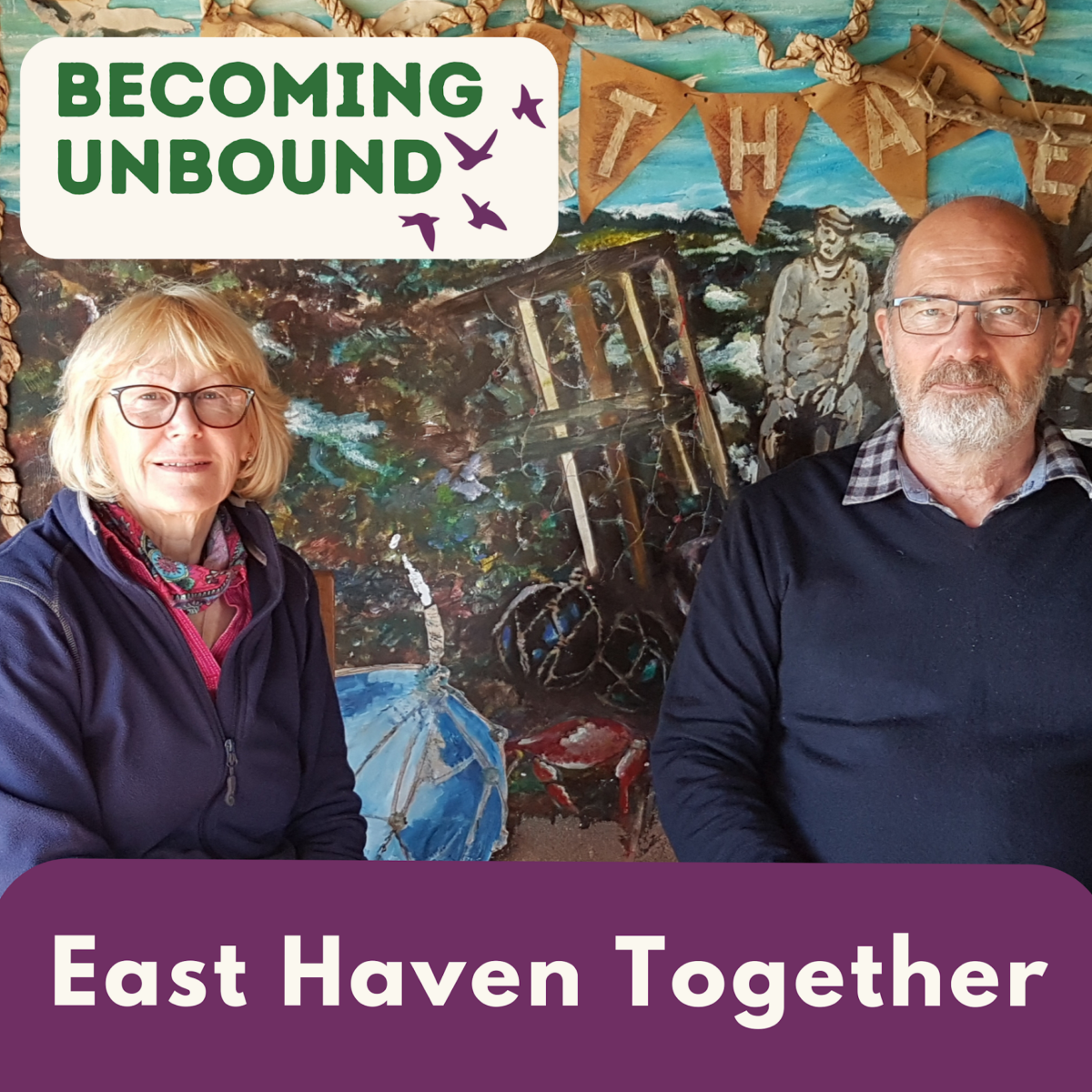
Join Kaska Hempel, our Story Weaver, for a conversation with Wendy Murray and Jerry Forteath from East Haven on the Angus coast, to hear about the incredible story of their journey with East Haven Together.
Hosts Sam Jordan (Scottish Community Development Centre) and Ruth McLaren (Scottish Communities Climate Action Network) listen alongside you, reflecting on what this story reveals about community power, climate action and the questions shaping their work as members of the Unbound communications team.
Becoming Unbound is the pilot podcast mini-series for the Unbound Scotland project, which supports community-led action on climate and health across Scotland.
Through conversations rooted in lived experience, the series explores how communities are responding to climate and health challenges – and how these stories can help shape the future of Unbound.
Resources and links
Unbound Scotland project website: https://www.unbound.scot/
Find out more about East Haven together here: www.easthavenangus.com
Transcript
HOST INTRODUCTION
Ruth McLaren: Hi, I’m Ruth. I am the Communications Weaver at Scottish Communities Climate Action Network, also referred to as SCCAN, and I’m joining today from the Isle of Arran.
Sam Jordan: Hi, Ruth. I’m Sam Jordan from SCDC, the Scottish Community Development Centre. I also work on the comms there, and I’m joining from Bishopton in Renfrewshire.
Ruth McLaren: Cool. We’re both part of the Unbound project, which supports community-led action on climate and health across Scotland.
Sam Jordan: Yeah, and in this pilot podcast miniseries, we’re listening to some community stories and taking a bit of time to sit with them rather than explain them and see what we can come up with around climate, health and collective action as well.
Ruth McLaren: Yeah, and to really pay attention to what communities are already doing and experiencing while we shape our own work on Unbound. So Sam, where are we heading today?
Sam Jordan: Today’s story comes from East Haven, a small village on the Angus coast between Carnoustie and Arbroath. Not a place that I have been, but I was really interested to kinda hear about some of their experiences.
Ruth McLaren: Yeah, me too. I’ve actually never been there either. So last October, Kaska Hempel Unbound’s storyteller, went to meet Wendy Murray and Jerry Forteath from the local charity, East Haven Together.
Sam Jordan: Wendy’s lived in the village, I think, for about 35 years and is a lead trustee. And Jerry moved a bit more recently, about three years ago, and ended up chairing the steering group for their local place plan.
Ruth McLaren: Which was actually the first one of its kind in Angus.
Sam Jordan: I think they met in a croft shed overlooking the sea.
Ruth McLaren: It sounded lovely. It sounds like a really good setting.
Sam Jordan: Yeah. Especially, I think it was – … from the audio anyway, a nice, a calm and sunny day, just a week after Storm Amy, which hit the area with some high winds.
So I think Kaska was probably glad to have missed that at least.
Ruth McLaren: Yeah. And you can even hear the occasional train going past in the background and some birds.
Sam Jordan: Lovely. Should we have a listen?
[Sound of train passing]
COMMUNITY CONVERSATION
Kaska Hempel: The weather’s fantastic. And we’ve got the big door open. Did it used to be a boatshed?
Wendy Murray: Yes!
Kaska Hempel: And we’re looking over the water and listening to little twittering birds, so it’s a perfect spot- and a perfect day for this.
So I wanted to get a feeling for what your East Haven is like. If you could share something that you love about this place, and maybe you have a favourite spot.
Jerry Forteath: My house looks right out onto the sea, which, on a day like this, is lovely. And a day like last Friday, it was an absolute gale. You couldn’t really see out the windows because there was so much spray. So it’s very variable in terms of weather, but that’s one of its attractions.
I do have a bit of a favourite spot at the moment, because there’s a log that’s washed up just down from the dunes just by my house, and I’ve taken to sitting on it and just spending time.
And it’ll probably wash away next time we have a storm, but that’s my spot.
[Laughter]
Wendy Murray: I think, like Jerry, I love the beach, but I also love the shed. And the shed’s really become quite important. We’ve had lots of community groups using it, but that also includes women’s groups. Women who’ve perhaps found themselves in really difficult situations and have become quite anxious, and this is a great place for them to come in the winter because it’s dark, there’s no electricity, and there’s absolutely nothing.
But what they can learn is that it’s a safe place, and they learn how to be resilient. That we can use battery lights, that we can use things to keep ourselves warm. We don’t need a lot and we can manage together.
Kaska Hempel: Wow, what a spot. Any sort of challenges?
Jerry Forteath: One of the things is I have a little box near my front door where I have torches, candles, all sorts of things that I should need if the power goes off.
And that’s one of the first things that I think you learn to do when you’re here. So it’s about personal resilience as much as anything else. I
Wendy Murray: I think for me, one of the biggest challenges is the restricted access under the railway bridge, because that means that we have great difficulty in sometimes accessing emergency services, in dealing with coastal incidents.
So we’ve actually had to purchase, as a community, an all-terrain vehicle so that we can even support the emergency services, so we drive them to incidents along the coast. The other challenge actually that is quite tough for everybody in the village is that a lot of the roads are in historic ownership.
So we have to manage all our own roads and streetlights.
Kaska Hempel: We’re here today to explore your own and your community’s journey towards resilience from, what one visitor said, the worst place he had ever set foot in, to a multi-award winning village now involved in active climate resilience and place planning, which sounds pretty amazing. But let’s start from the beginning, and I think Wendy, you’re the person to talk about, before 2012.
Wendy Murray: It wasn’t an attractive place particularly. Obviously, the beach was lovely, but it was littered. There was fly-tipping, and we had a lot of antisocial behavior around the public toilets. I was working, and as a village we set a residents association but we were very reactive. So we did that for, oh gosh, must have been 15 years.
And nothing changed. It just got worse. What had happened in 2012 is that National Cycle Network 1 had been extended to run through the village, and overnight we had a massive increase in visitors and people were telling us that this village of ours was really not very nice at all. They really didn’t like our public toilets, and one day we did have a visitor who was so upset that they said it was the worst place that they had ever set foot in.
And they actually looked at me directly and said, “Do you live here?” To which I said, “Yes.” And they said “you should be ashamed of yourself.” That came at a time when there were lots of concerns about how run down it had become. So we decided that we would carry out some consultation to look at what are the priorities of the community.
And everybody said : we’re actually going to be 800 years old in two years’ time -nobody knows that. We’re the earliest recorded fishing community in Scotland. Nobody seems to know that either. Residents had to come up with about 20 ideas.
Kaska Hempel: Wow …
Wendy Murray: About what they wanted to see in 2014, and it was just so massive. They wanted to do things like build a bridge, to develop community gardens. They wanted a festival too.
And initially we had thought we would just try and select one or two, but then realised that if we did that, some people would feel that their ideas were not valued. So we decided that we would try and complete on everything.
Kaska Hempel: Wow.
Wendy Murray: Somebody suggested we look at the three pillars of the Keep Scotland Beautiful framework, which are community participation, environmental support, and horticulture.
And one of the very first things we did was we contacted the BBC and we said “We are a very small community. Nobody knows where we are. We really want to get ourselves on the map, so would you put us on the weather map?” And Kirsten, the weather reader, phoned us up and said, “Of course.” And within days we had people contacting us. So we had all these stories that started to come in, and we decided that we would put it together in a little book.
The National Library of Edinburgh got in touch and said, “Your book forms a really important part of Scottish history, so we would like a copy for the National Archives.”
Kaska Hempel: So how did the celebrations go? –
Wendy Murray: They went really well, didn’t they? You would’ve visited Jerry at some point.
The Homecoming Festival was probably our most well-attended festival. We had planned for 1,000 people, which was huge for us.
Kaska Hempel: What’s the population size here?
Wendy Murray: A hundred .
So we thought we’d done planning for 1,000 people. In actual fact, on the day, 4,000 people made their way to East Haven, and it completely blocked the A92.
Kaska Hempel: It’s a tiny little road.
Wendy Murray: So it was just a crazy day, but people loved it. I think that interest came because we had reached out widely. We had worked with lots of different partners. We had involved not just our own community, but communities across Angus and further afield, and we had used storytelling to connect people to our village.
Kaska Hempel: Did you say you visited at the time? What did it look like from the outside?
Jerry Forteath: Very busy. I lived in Carnoustie at the time. I think my boys may have been involved in the band. Being just two miles away, I was familiar with East Haven, but I’d bypass it because I guess I wasn’t as conscious at that point that it was a really nice place, but not without a lot of work.
If you don’t pay attention and you don’t get the community together to act, it’s very easy for communities just to go into decline and then nobody really cares about it, and you tend to think it’s impossible to do anything about.
Wendy Murray: This whole process has brought home to us is that even the smallest village, the smallest group of people can make an impact, not just locally, but nationally.
Kaska Hempel: It’s really empowering, isn’t it?
Wendy Murray: Yes. After 2014, we knew that if we became a charity, we would have a lot more opportunity to bring in funds and since 2014, we’ve actually brought in over £270,000 into the village. We’ve refurbished our public toilets. We’ve installed the solar lights. We have bought our all-terrain vehicle, gardening equipment, lots of resilience equipment.
Kaska Hempel: You mentioned something earlier about sand dune monitoring. What was the reason for that?
Wendy Murray: When we first moved here in 1990, there was a big storm, and we lost several meters of dune in front of the house. And at that time you could simply phone up what was called the Scottish Office, which we did, and said, “We’re really concerned about this.
We’ve lost a lot of dunes.” and they said, “Yes, not a problem. We’ll come out straight away, and we will bring NatureScot and Caledonian Geotech,” who the Scottish Government employed to look at coastal erosion and beaches even way back then. Along all these people came. Professors came from St. Andrews University, Dundee University. They told us that they had actually been measuring the beach here since the ’70s. And they asked us to start measuring the dunes to add to their data.
And we were particularly pleased to do that because our local authority had decided that it would support the installation of hard defenses three miles down the coast at Barry Buddon, and the couple of miles up the coast to Elliot. There was concerns that installing hard defenses might have an impact on areas where there were no defenses. And because Angus Council don’t own any of the beaches really between Carnoustie and Elliot, they were not prepared to put in rock armor. And certainly for our small village, we weren’t seen as valuable enough to protect.
Kaska Hempel: Sacrificial land.
Wendy Murray: Yeah.
Kaska Hempel: Yeah.
Wendy Murray: And NatureScot asked us to remove invasive species. Invasive species undermined the root system for the natural lime and marram grasses, and these grasses protect the structure of the dune system.
Kaska Hempel: And it’s the dunes that are a protection zone for you.
Wendy Murray: They’re our only protection. So we knew then that we had to really start to take much more responsibility over the dune system. I think it gave us some control, something that we could do.
Kaska Hempel: So maybe we could fast-forward a little bit and talk a bit more about the challenges with flooding recently.
Wendy Murray: We are in a very difficult position geographically because on one side we’re bounded by agricultural land and some very old drainage systems, which has an impact on the landward side of the village, and we have had properties flooded since 2020.
And then we’re squashed between that area and the eroding coastline, rising sea levels. So last year we managed to get a big floodgate installed to prevent sea surges from flooding houses, and we got quite a bit of funding last year … to do that. We do dread the winter months or when the rains do come. Because we have lots of infrastructure that is causing flooding … to property.
Jerry Forteath: Yeah. Some houses have had basements a meter or more full of water.
Wendy Murray: And people impacted by these events- really do suffer physically and mentally, and that is partly because they can never sleep for thinking, “What’s happening now?
How high is the water? Is the pump on?” And also the worry about whether insurers will pay out.
Kaska Hempel: That’s right, yeah.
Wendy Murray: It’s just a terrible thing to live with. And we had a couple at the top of the road that were completely flooded out and had to move out last year, and their house repaired maybe over a period of 18 months, move back in and worry, “Is it going to happen again?”
We also had a sinkhole on the railway line in January 2024, and all the water’s been diverted from the main railway culvert into pumps, which are now having to transport the water into the burn.
Kaska Hempel: Oh, so that’s the pumps that are set up just before you go under the underpass.
Jerry Forteath: Much to the annoyance of people who live next to it.
Wendy Murray: So that has been a massive challenge because Network Rail don’t have the funds that they used to have … to repair these things. The pumps have burst from time to time. The pumps themselves have gone on fire.
Increasingly, we’re feeling that it’s something that we’re gonna have to take more control of ourselves.
I would say that we have been largely coordinating everything, and it’s not that long since we sat down in our front room with local authority, Network Rail staff, trying to look at roles and responsibilities, but it would appear that these national organisations are so badly resourced now that they’re not in a position to do what is required for communities, which is really frustrating.
Because it’s leaving communities to apply for charitable funds to try and keep the water out. It’s not resolving it at source.
Kaska Hempel: You said that you’ve been working on the place plan. Is that something that you’re hoping is gonna address some of these issues?
Jerry Forteath: So the local place plan is really an opportunity for a village or a town to put together a plan for the next 15 years based on consultation with the people who live in that area.
We’ve started a consultation process, which has been running since the beginning of the year and we’ve identified what the priorities are, and at the moment the draft’s out for consultation, and then we’ll be submitting it to the council. So what we are hoping to do is to influence the council in its development plans.
So it’s about being proactive really. Identifying what people value in the first place, but then putting it up to the politicians so that they know and they don’t have to be searching around for information. They’ve got it.
With the flooding issues, we want to make sure that local politicians understand. It’s an absolutely traumatic event and it totally disrupts your life for probably a couple of years at least. So so we want to get that in sight of the politicians … so that they can do what they can to help us.
Kaska Hempel: Did you have any ideas as a community in terms of what would help reduce the flooding?
Wendy Murray: So the local place plan has given us that opportunity to think more deeply about that. We have to work very closely with Network Rail, Angus Council, the landowner, because obviously the field drains and the way that the land is managed is crucially important. So we could raise funds, if we can come up with a solution, such as perhaps diverting some field drains further away from properties.
On the seaward side, we really are reliant on natural protection. It’s not just about what we do with dunes, but it’s about education, and it’s about engaging the public. Because we really need the support of the wider public to help us to avoid wildfires. If we had one wildfire that wiped out our entire dune system, we could lose our properties.
Kaska Hempel: And I guess that’s actually increasing that risk.
Wendy Murray: It is.
Kaska Hempel: It’s increasing with the drier summers.
Wendy Murray: It is. It’s massive.
Jerry Forteath: We had two months this summer where I don’t think it rained at all.
Wendy Murray: Yeah.
Jerry Forteath: Really worrying drought. So things were really dry. …
Wendy Murray: So we take the approach of welcoming the public, providing lovely toilets, a great experience for people that are coming to wild swim.
But using nudge strategies, we say to people, “Please have your picnics, please barbecue, but do it safely. Do it away from the dune system.” So it’s about public education, getting them on board, and to do that, you have to provide them with something. This is what we do, and this is what we would like you to do.
So it’s sharing responsibility. And one of the wonderful things about the local place plan is that 298 visitor and stakeholder surveys were undertaken.
Kaska Hempel: Oh, that’s a lot of voices.
Wendy Murray: We were thrilled about the huge number of people that said that the natural environment was important.
So it feels that we have that buy-in from the wider community, that we have their support. Our main job is to be custodians of the coast, and we really have to maintain that dune structure.
We have done work with the fire service as well. We have live exercises. We have to because they can’t get their vehicles under the bridge, so if there was a fire, they can’t just come and put it out. We have to use our ATV. So this year we’ve raised funds to buy a special trailer. They need to get their pumps and pump water from the sea back onto the dunes.
But one of our residents has been great over the last 10 years at growing lots of natural lyme and marram grasses from seed. We’ve planted thousands of them out onto eroded areas of the dunes, and we need more residents to get involved. So we’re going to have a community workshop so that people can learn more about how you harvest seeds, how you plant them. Again, it’s engaging people in something that they can physically do to protect the coast, and that gives people that sense of control that they’re doing something.
Jerry Forteath: Yeah, because I think one of the things with climate change is it can seem absolutely immense, and therefore what can you do? But actually, there are things that you can do that will have an effect. And I think one of the things with the place plan and how this interfaces with it is it’s raised awareness amongst the residents about the diversity of issues that we need to look at.
And if they buy into it, then things like the planting of the marram grass are practical aspects where they actually implement it. What we don’t want is that the residents think “Fine, we’ve got a plan. Now you’re gonna go and implement that with the council, and we’ll just wait for it to happen.”
That’s not really what we’re looking for. What we’re looking for is for people to do their bit.
Kaska Hempel: I seem to remember, Wendy, that you mentioned that dealing with extreme weather events had an effect on how you thought about how resilient the community was. Would you mind sharing that?
Wendy Murray: We have been resilient for many years, but we didn’t really recognise that word until we became involved with the Angus Resilience Forum in 2017, and it was at that time that we produced our first resilience plan.
Initially, it was about how we are resilient as individuals. Things like, you do need to have your torch ready or whatever it was. Since then, we have actually begun to look wider than our own community. It hadn’t really occurred to us before our involvement that other communities had challenges too. And we now know what they are, and we also have systems in place to share equipment, support each other.
But the other thing that it has done as well is it’s made us think beyond our own front door. We developed a plan looking at how every single house works and which properties are going to be impacted most in storms. Who will it be that is not going to be able to cook food? Who is it that’s not gonna be able to get a hot drink?
So we now know where our hot flasks have to go to. We now know who we could rely on to heat up the soup because we’re not a priority for some of the food vans either, because we’re too small.
Kaska Hempel: That’s an incredible amount of work.
Wendy Murray: It is a lot of work. Another interesting piece of work that we did in 2021 after Storm Arwen, we decided that we would visit every household in the small communities that surround East Haven, and we found that some of the impacts on people in rural properties was just horrendous and that people had been left in really difficult situations.
I remember that if you rent a cottage, as many of them do, it means that they’re not eligible for compensation from SSEN. We were without electricity in our village for four days, and every resident that was without electricity got compensated.
But those that live in rented cottages, the compensation goes to the person that supplies the electricity to that cottage, so it went to the landowners.
I remember one woman, she has a learning disability. The main thing in her life is her tropical fish. All her fish died in Storm Arwen because she wasn’t able to keep the tanks going.
And she didn’t get any compensation, and she wasn’t then able to replace her fish. That’s just a small thing, but when you think if that’s somebody’s life, the psychological impact of that is enormous. So more thought is gonna have to be put into that in the future, how we support people that are really vulnerable and at risk.
I give the local authority and that Resilience Officer great credit because they had the foresight to realise what climate change was going to mean for communities, and they decided to set up this forum to strengthen communities, to provide those connections, to have that shared learning and shared support for each other.
We have a joint WhatsApp, and you can see immediately if something’s happening in another of our communities. I personally find that a bit upsetting sometimes because it makes me feel a bit out of control because I can’t help. But at the same time, it’s helping that community because they know that we know. They know that we are supporting them, and I think that’s what it’s about.
Kaska Hempel: Now, we’ve talked a lot about resilience. Can I ask you both the first thing that comes to your head when we say community resilience?
Wendy Murray: Fight!
Kaska Hempel: Great!
Wendy Murray: Be strong!
Kaska Hempel: Yeah.
Wendy Murray: Make your voice heard.
Jerry Forteath: I think support because particularly here, if somebody needs something, the WhatsApp in the village will get a response within almost seconds.
Wendy Murray: And that is another thing which in our local place plan emerged that although we have all these challenges, the residents report feeling very safe living here.
Jerry Forteath: Yes.
Wendy Murray: So it just shows that communities can put things in place that can make people feel safe. A lot of that is very achievable because it’s about people.
It’s about … what we can do for each other.
[Bird singing]
Kaska Hempel: Ooh.
Jerry Forteath: Is that a robin? Yes. Joining in.
Wendy Murray: Yeah, maybe it was. Listening to us. Yeah.
Kaska Hempel: Agreeing. . Yes, I’m with you.
Another question relating to resilience, it can be hard to pinpoint and measure. Do you have any indicators that you keep track of?
Wendy Murray: We do try and collect as much data as we can about as many things as we can, and we have hundreds of records, don’t we? But as Jerry said, we importantly have that feedback through the local place plan.
Jerry Forteath: And one of the things we used in the local place plan was .. place planning tool, which includes feeling safe as one of the indicators. And I think going forward, we would be looking at doing that maybe annually just to check how are people feeling. Are they feeling any different?
Wendy Murray: And the place standard tool was good because it had 11 themes … and people had to rate how much they felt supported within each of these themes.
So feeling safe was one of the highest responses. The other thing that there was a high response on was a strong sense of identity and belonging, and the things that they said had given them that was that the village charity gave them a voice both locally and nationally. I think the place plan has given us that sense of what is valued and what people really appreciate about the place.
Kaska Hempel: Now, that’s quite a journey. Reflecting back on it, is there one biggest thing that you’ve found most useful?
Wendy Murray: I think you have to work with partners. We work with 30 to 40 different organisations and really ensure that you are listening to all voices.
Jerry Forteath: I think one of the things as well was being open and sharing what we were doing.
Because we had some interest from Carnoustie for doing a local place plan. And we’ve looked at other place plans as well, and that’s been helpful. Although they’re all really different.
Wendy Murray: So we’ve made a page publicly available on our website. Where we’re providing a step-by-step guide, and it’s purely community led.
Because I think a lot of communities now, unfortunately, are thinking that they can’t do anything unless an external consultant does it for them. And we have to get away from that. Communities have the power within themselves to do it. Because one of the things you learn living in a smaller community is that everybody who lives here brings either life experience or previous work experience that you can draw on. It doesn’t matter who you are, you’ve got something you can contribute.
Jerry Forteath: Yeah. It’s about involving people at a level that they’re comfortable with.
Wendy Murray: Yeah. Being really inclusive.
Jerry Forteath: Maybe not making assumptions about
Wendy Murray: What people can do and can’t do.
Jerry Forteath: Because they might not even realise it themselves.
Wendy Murray: Yeah.
Jerry Forteath: And I think you get more ownership. We could act on an unpaid basis as consultants for people if they wanted to do a place plan. Some of the basic stuff, if people were starting off, what do we need to look at?
Kaska Hempel: How do you see East Haven Together, and your role within wider Angus, let’s say, medium to long term?
Wendy Murray: We have a vision for 2040.
Kaska Hempel: So that was part of your place planning?
Wendy Murray: Yes.
Kaska Hempel: Oh, wonderful.
Wendy Murray: Yeah. The vision is about East Haven being a safe and accessible place to live, where the natural environment is protected as far as possible in the future.
Jerry Forteath: And… with services to support a thriving community.
Wendy Murray: Yeah.
Jerry Forteath: Almost word for word.
Succession planning was my thought that popped into my head because these things don’t tend to happen themselves. You need people who are prepared to put in the effort and drive things. And I would say, Wendy has been the predominant figure in that.
However, at some point, Wendy, you might decide that, “Don’t wanna do that anymore.” Or, or you might, move away or something like that.
So we have to think, I think, as a community about how do we continue to take things forward? We have written this into the place plan. What we’re looking at is people being involved in taking different projects forward. People who can take over when any of us want to give up.
Kaska Hempel: So is there any sort of place for how you fit into wider Angus or Scotland, or do you have an idea?
Wendy Murray: We very much see ourselves as connecting locally and nationally. And we do work with a whole range of national organisations and we try to work on a political level sometimes to create change.
Kaska Hempel: I can see that you’re seeing yourself being an influencer into the future.
Wendy Murray: It’s just trying to make people think that doesn’t matter how small the community, you can make your voice heard.
Kaska Hempel: Is there any resources you think you don’t have, or support or help you think you might need in the future that would make you achieve better resilience?
Wendy Murray: I think if the Scottish Government is going to continue to take resources away from statutory organisations and try and make communities take responsibility for themselves, we have so much to offer, but if they’re going to make that big shift, then they have to help resource communities as well. A community like ours needs a couple of thousand pounds every year just to keep running, and we then have to raise that.
So I would like to see where you do have charities that can evidence that they are delivering on government objectives, that perhaps a small amount of money could be given to support their core running costs. That would actually make quite a big difference to us.
Kaska Hempel: Yeah. Sea level’s gonna be rising potentially. You’re gonna have losses in the community in terms of land and property. Is this something that you’re thinking about? It’s massively challenging.
Wendy Murray: Yeah.
Kaska Hempel: And I know it’s really hard to have conversations even … about it in communities. Are you talking about it?
Wendy Murray: It’s a very interesting question for me because when I started the work in the ’90s, people generally in the village asked me to keep quiet about it, not to talk about it, because they didn’t want any impact on their properties.
That has changed in more recent years in that people have become involved in the work we’re doing to maintain the dune system, and so there’s a lot more conversation. But I think what has changed for me particularly over the last year is the fact that now it’s been identified as a big issue for the community through the local place plan, that has opened up conversations.
But the other thing that has particularly changed was my experience of attending the Coast-R conference. From that, it emerged that work is going to probably progress, I would say, fairly quickly over the next couple of years at developing community conversations around coastal adaptation, and I can now see a way forward for the first time in years that has the potential to happen.
And I heard just recently as well that the Scottish Government have now made a suggestion that any community that lives within 12 miles of the coast should be identified as a coastal community. So it makes it less personal. It makes it a bigger issue.
I think we need to get to the level that they are in France, where these conversations have been much more open and they have developed policies for coastal communities to protect people, to protect places, to protect assets, and giving people that security. It’s not that they can’t necessarily protect them in the place that they are, but protect them if they need to retreat.
One thing I’ve picked up from the Scottish Government is that there’s been caution at a fairly high level in Scotland about these conversations because if they discuss them with communities in Scotland, it’s just going to frighten people. And there are no plans. We don’t have any policies. We don’t have those support mechanisms in place yet. We don’t know what they look like. So we’re playing catch up in a way. But maybe it does need communities like ours to help those conversations, to help strengthen them and to say “Come on. Let’s get around the table and talk about it.”
HOST REFLECTION
Sam Jordan: So we just heard Wendy and Jerry’s story there.
I was really struck by how some of the issues they face are so specific, they’re so detailed, they’re so local and about climate challenge that’s right at their doorstep if that makes sense.
Ruth McLaren: I think the thing that really strikes me is the fact that the community took control.
They’ve described this as quite an overwhelming threat. There’s a lot of moving parts to it. They have to speak to so many people and involve so many people in the solutions. They’re talking about landowners, local authorities, farmers, Network Rail, the fire service, emergency responders. It’s all so complex. And yeah, it just, it feels like such a big thing to take on as a community.
Sam Jordan: Yeah, for sure. And it makes me think about of having to take on such a big challenge and the kinda quiet, almost unseen impact of having to deal with what is effectively a global issue, but also one that’s incredibly localized.
And thinking about the slow drip feed of anxiety that comes from that, of not feeling secure in your own locale, of not being able to know that your house is gonna be there the morning after a storm, and how that compounds over the course of a broader community And how people, I think in this case, have really fantastically come together to tackle that challenge.
But that we shouldn’t maybe forget that’s a really difficult thing to be dealing with day-to-day, and then to have to bring together and act in a way that is collective and make sure that the whole community’s involved as part of that response as well.
Ruth McLaren: Yeah, you’re absolutely right.
I think that’s something that kinda stays with you as well, is like the emotional impact on the community of having to deal with climate impacts, especially when they were talking about the pump under the railway bridge. That’s a solution, but then it’s creating another annoyance. Imagine having to listen to that pump going 24/7.
That would really do your head in. That must have quite an impact on the people living near that. And okay, it’s a solution. It’s not really a great outcome.
Sam Jordan: And I suppose those kind of impacts, those kinda small day-to-day impacts are something that I was reflected on as well listening to their story and how that will compound over time in terms of there’s having to deal with maintaining the pump but also the dune collapse and all of these things compound into actually creating what is lots of small issues it felt like. But brought together, compounding into something that is obviously a wider issue.
And having to relate those two things, that bigger sense of crisis that people live in with the day-to-day- “Oh no, I can’t get to where I need to be because there’s been a storm,” or whatever the impact is. We’ll see different ones across communities. But that dynamic, I think, is something that is going to become more common as people deal with the wider impacts of climate, and then how does that impact their lives in different ways?
How does that impact their health, for example?
Ruth McLaren: Yeah, I think the mental health is a huge part of all these conversations.
On the positive side of that, it feels like the community is super connected through the WhatsApp group and through real solid community networks, which on the flip side of that, bring really positive connections and really strong communities are good for your mental health.
Knowing that somebody’s at the end of a WhatsApp even if there’s only limited things that they can do in that moment, you know that somebody’s there, and that’s a really comforting thing. And the fact that as a community they’re really focused on safety is such an amazing thing because who doesn’t want to feel safe in their community or where they live?
I think that’s something that can resonate with every community across Scotland.
Sam Jordan: For sure. I think that idea of safety is something that we… Maybe it’s just me, but I don’t necessarily think about it in that sense of around climate safety. I think that feeling climate safe is maybe something that increasingly we’re gonna be having more conversations about.
Because if you’re living in an environment where there are threats in terms of erosion or whatever the issue is, how do you build that resiliency? How do you build that cohesion across the community? Which I think you picked up on as well, and that actually takes work, it takes time, it takes community capacity, we would say, from a community development point of view, in terms of being able to come together.
All of these different factors that build community cohesion, community resilience. They stem from maybe what feels like a really challenging or even threatening impetus, but actually they kind of bond people together as well. I think maybe what we heard in the stories, those bonds being developed and formed.
Ruth McLaren: Yeah. It’s interesting, the kind of idea of safety in terms of climate. Because when you think about safety in this way, I immediately start thinking about preppers. People who are building bunkers and preparing for the end of days. And I think that was definitely a thing during COVID that people can relate to now, a couple of years on, was that need for protection and safety it was a massive thing.
I’d love to know how this community, I bet they did really well during COVID with all these systems set up. It sounds like they have a really good, strong community, and they know how to respond.
And something that really strikes me, actually, is a lot of it is about communication. They communicate really well within their community as individuals, and then they are also talking about all these other – stakeholders, is the right word – all these other organisations and local bodies. The local place plan is a means to get action for their community and to make positive changes for their community.
There was a quote that really struck me where they said, they’re using it as a lever to make their politicians understand what they’re experiencing in their community. And that made me feel a little bit sad because these are elected representatives, they should be able to understand.
But it sounds like East Haven are being really proactive in that mission to engage with their elected officials for their community not to be left behind and to be represented. And then on top of that, they’ve realised the benefits that potentially other communities could experience by doing some of the things that they’re doing and communicating with other communities across Scotland.
So I guess it’s not surprising, myself being interested in communications, that’s something … I’ve noticed, but I think that’s really quite a central part of the work that they’ve done is building up and communicating their story really.
It just feels like they’re relentless. I think that’s really cool because you have to be.
Sam Jordan: Yeah. Yeah. No, definitely. And that’s something that I think that comes through really strongly in Wendy and Jerry, their real drive and their passion. But I’m thinking about maybe some of the communities in Glasgow that I’ve lived and worked. In Govanhill, for example, and there’s gonna be different challenges there.
Many areas of Glasgow suffer deprivation and poverty and oppression. There are people who are facing really difficult circumstances in their own lives that maybe don’t have the same knowledge, skills, opportunity to come together in this way. I guess thinking about how … how do we address that? How do we address that as a wider issue?
But then at the same time, I think there’ll be inequality throughout or maybe hidden in the way that you might see in a more urbanized area, especially rural versus urban. So just trying to kinda get at that balance, in terms of that’s the reality for many people. That’s the reality of their experience.
How do we ensure we capture that? And that’s something that definitely struck me from listening to this story.
Ruth McLaren: Yeah, that’s a really good point, and I think certainly thinking about my community and other places that I’ve lived is the sense of frustration needs to be acknowledged.
I feel like communities given the opportunity and the voice, they know what they want. Communities know what they need. And it’s matching that up to reality.
Something that was spoken about that kind of bothered me a bit was these man-made or incidental injustices that are being experienced. They were talking about the power cut compensation going to the homeowners rather than the tenants. Personally, I would hope that the homeowners would be passing that money on to the tenants, but, the fact of the matter is that there’s not a system in place to make sure that’s happening.
That’s just fundamentally wrong. That noise from the pump under the railway bridge. Why? Why should Network Rail not be fixing that? I don’t feel it’s fair to say, “Oh there’s not enough money for these things,” which are so fundamental to the way people live.
You know that story, ugh, the story about the fish, that poor woman! Now I’ve got a dog and I love my dog beyond all logic and reason, and the thought of that happening, just sitting in a power cut and my dog basically dying, that really just drove a dagger into my heart. It just, it’s just so sad.
It’s just, it’s the unfairness of a lot of these situations. The physical impacts, erosion, and the climate impacts is one thing, but surely we can all be doing better to address these other injustices which are more within society’s makeup I think.
Sorry, that’s a bit of a rant there I had to get one in.
Sam Jordan: Not at all. Not at all. There’s, I think, something really interesting in how they acknowledge and talk about the skills that they’ve got across their community. Harnessing those skills, harnessing that knowledge that they’ve got, bringing it together.
Ruth McLaren: Yeah. And it’s very much rooted in place.
They talk about identity and belonging, and involving everybody, and the fact that everybody can contribute. If you’re a baker, a bus driver, a postie, an engineer, a seamstress, everybody has things that they can contribute, and everybody- loves, maybe not everybody, but in general, everybody loves the place that they’re living in. And it’s thinking about the threat of climate impacts, it can be quite a depressing and scary subject.
Let’s be honest. But I think if you can push through that and always come back to the community. That’s how I spend a lot of my “dark days” being inspired by other people. But yeah, if you can bring it back to the community and don’t even think of it as like climate resilience or impacts, if you just strip it right back and think “how to make this place better,” everybody’s gonna benefit from having a nicer place to live.
And uniting people that way, I think, is what they’ve done. And it’s also a really good way forward.
Sam Jordan: Yeah, for sure. From my community development background, it takes me to, how do we translate that, to communities that maybe have different aspects of the climate crisis to deal with, but also discrimination and inequality that we see.
And in health, I think 70% of the things that impact someone’s health, it has nothing to do with the choices they make in terms of food or diet. It’s all about environment. It’s all about the things that you use that surround you, things that you can’t control. It does relate so keenly to, very bluntly, how long people live.
You know what I mean? That’s the stark reality that we live in, is that people die earlier because of where they live. And for me, it feels like climate really does sit as a central part of that. It sits at the heart of inequality. So I think there’s something then about how do we ground that in the reality, as you say, community experience.
I think that’s a challenge. That’s something for Unbound to be unpicking as well over the course of this work. And definitely at the forefront of my mind.
Ruth McLaren: Yeah, for sure.
Something that took away from it was the kind of empowering thing is East Haven now have a plan, and not only do they have a plan for their local community, but they’re helping other communities.
And I feel like that’s where the movement is gonna need to go to make things positive, because there is an element of frustration that there’s a lack of resources, there’s a lack of funding, there’s a lack of support. But as communities, we really can’t wait. But perhaps with the work, more funding and more help might come is maybe what I would hope for.
Sam Jordan: Wendy talks about all the ideas that came from that response, and it goes to your point absolutely. The ideas are there, the drive is there. Communities have that in them. It makes me think of the recent march in Edinburgh organised by the Poverty Alliance, Scotland Demands Better, which is focused on poverty, but actually these issues are things like winter heating, all of the actual dynamics of people’s lives, all the things that people actually are grounded in, stepping back, you can see really clearly the relationship to climate, the relationship to health.
And so I think it’s about how do we have that conversation, as you say, how do we raise the profile of that? And that’s from two communications people, I suppose that’s something that we’ve focused on. But bringing and championing community experience, lived experience, all of those voices that maybe aren’t heard around this issue. How, as you say, how do we raise that? I think that we’ve got a challenge on our hands in terms of doing that across comms front, I think. But it feels like a good place to be able to start, just as we have with East Haven, telling those stories as well.
Ruth McLaren: Yeah. And just think, it all started from one rude comment about the toilets.
Sam Jordan: That’s what it takes sometimes, isn’t it?
Ruth McLaren: I really wanna go and see these toilets, I have to say.
Credits
- Kaska Hempel (design, production, community interview, editing)
- Blip Blop Tuesday by kjartan_abel — https://freesound.org/s/558270/ — License: Attribution 4.0